A leading business law firm in Denver, Colorado

Indemnification in M&A Transactions: A Comprehensive Guide for Selling Founders

Table of Contents

When selling a privately held company, one of the most overlooked—and misunderstood—elements of the deal is indemnification. While most sellers focus on the headline purchase price, the reality is that indemnification terms often determine how much of that price sellers actually retain after closing.

At Linden Law Partners, we specialize in representing founders and selling shareholders in private company M&A transactions. Through this guide, we help demystify indemnification and arm sellers with the knowledge to protect their upside and minimize long-tail risks.

Indemnification provisions in M&A agreements are a minefield of legal and financial nuances that can either safeguard or severely erode a seller’s post-closing proceeds. Sellers who approach this issue with strategic clarity—and who negotiate from a position of informed leverage—are far more likely to exit with the full benefit of their hard-earned business value. This article goes well beyond the basics, offering sellers a full-spectrum view of indemnity exposure, the mechanics of post-closing claims, and how to negotiate favorable terms.

Escrow Structuring and Administration

Escrow Structuring and Administration

Escrow arrangements are central to indemnity enforcement. Even the most well-drafted indemnification clauses are only as good as the funding mechanism backing them. In most M&A deals, a portion of the purchase price (typically 10-20%) is held back in an escrow account to satisfy potential indemnity claims.

This escrow account acts as a source of security. Without it, buyers may struggle to enforce indemnity rights, and sellers may face delayed or disputed claims well after closing. The mechanics governing escrow disbursement are equally critical. Sellers should ensure the agreement defines:

  • When funds may be released
  • What types of claims justify disbursement
  • Who controls the account
  • How disputes are resolved

Many deals also establish separate escrows for specific risks, such as tax liabilities, litigation, or environmental exposure. These bespoke escrows may survive longer and be excluded from general caps and baskets.
Clear and strategic escrow structuring and administration not only limits post-closing surprises but also facilitates smoother exits by preemptively resolving funding questions.

Reps and Warranties and Indemnification Exposure

Indemnity claims typically arise from breaches of the seller’s representations and warranties. These are the factual assertions a seller makes about the business, ranging from its financials and operations to compliance and legal standing.

Each rep is a potential landmine if misstated—even unintentionally. The accuracy, scope, and qualifications of these reps directly affect indemnity exposure.

Key protective tools include:

  • Knowledge qualifiers: Limiting reps to facts known by specific individuals
  • Materiality thresholds: Reps only apply to matters of material consequence
  • Disclosure schedules: Detailed carveouts that limit liability by documenting exceptions

Through a focused reps and warranties review and advisory assistance, sellers can revise overly broad reps, limit subjective standards, and ensure the disclosure schedules are doing their job.

General vs. Fundamental Representations and Warranties

Understanding the distinction between general and fundamental reps is vital. It’s not just legal semantics—it determines how much a seller can lose, and for how long.

Indemnification for these types of reps are often:

  • Capped at 10% or less of the purchase price
  • Subject to baskets
  • Time-limited (12–18 months)

Fundamental reps, by contrast, go to the core of the deal:

  • Title to shares or assets
  • Authority to sell
  • Capital structure
  • Taxes
  • Brokers and finders

Indemnification for fundamental reps are frequently:

  • Capped at the full purchase price (or uncapped in some cases)
  • Not subject to baskets
  • Survive much longer—or indefinitely

Sellers should be cautious: Some buyers attempt to stretch the definition of “fundamental” to include things like intellectual property or customer relationships. Careful custom indemnification provision drafting can stop that overreach before it starts.

Covenant Breaches and Indemnification

Covenant Breaches and Indemnification

Covenants in M&A agreements are promises about future or pre-closing conduct. For example:

  • A seller might covenant not to solicit customers post-closing (non-solicit)
  • Or to provide transition services for 90 days
  • Or to operate in the ordinary course until the closing date

These covenants can trigger indemnity liability if breached—even if reps and warranties are untouched.

Key considerations for sellers:

  • Pre-closing covenants should expire at closing, unless essential
  • Post-closing covenants must be tightly scoped in duration, territory, and obligations
  • Violations of post-closing covenants are often excluded from general indemnity limits

Sellers should conduct a survival period structuring and legal strategy analysis to ensure the risks from covenants don’t exceed what’s fair or expected.

Representations and Warranty Insurance (RWI)

Over the past decade, RWI has revolutionized private company M&A deals, especially those involving private equity buyers. RWI is an insurance policy that covers the buyer for losses arising from breaches of reps and warranties.

When RWI is used:

  • The insurer—not the seller—bears the risk of breach
  • The seller’s indemnity obligations are often reduced or eliminated
  • Escrow amounts are often lowered (or waived entirely)

But RWI is not a silver bullet. Policies:

  • Exclude known risks, like pending litigation or tax issues
  • Require retention amounts (i.e., deductibles)
  • Only cover specific types of reps, not covenants or post-closing conduct

Sellers should work closely with legal counsel for representation & warranty insurance consulting, ensuring that policy terms align with the M&A agreement and do not create mismatch liabilities.

Dispute Resolution for Indemnity Claims

Even with precise drafting, disputes happen. Sellers must plan for conflict.

An effective dispute resolution for indemnity claims strategy should include:

  • Notice procedures: Time limits and formats for claim submission
  • Third-party claim defense: Who controls litigation or settlements
  • Escrow release rules: Who decides if funds are released—and under what circumstances
  • Governing law and venue: Which state’s law governs disputes, and where they’ll be heard

Some deals include stepped resolution clauses:

  • First: Negotiation
  • Then: Mediation
  • Finally: Arbitration or litigation

Sellers should not blindly accept buyer-friendly dispute frameworks. A small change in who controls defense rights, for example, can dramatically shift leverage.

Buy-Side vs. Sell-Side Indemnification Strategy

Indemnification is inherently adversarial. Buyers aim to protect themselves from downside risk. Sellers want to preserve their hard-earned value.

Typical buy-side strategies include:

  • Long survival periods
  • Broad loss definitions
  • No materiality qualifiers
  • Low baskets / high caps
  • Escrows with buyer control

Meanwhile, smart sell-side strategies include:

  • Narrow, qualified reps
  • Knowledge and materiality thresholds
  • Capped exposure tied to escrow only
  • Tipping baskets with fraud carveout protections
  • Short, tailored survival timelines

Through experienced buy-side/sell-side indemnification strategy consulting, sellers can anticipate and deflect common buyer tactics—without unnecessary friction.

Conclusion: Don’t Let Indemnification Undermine Your Exit

Every deal has a price. But the real value of a business sale isn’t just what’s signed on paper—it’s what the seller actually keeps.

Indemnification provisions are where buyers often try to tilt the playing field. Without careful planning, they become a silent tax on your deal proceeds. Sellers who proactively manage indemnity exposure—through precise drafting, negotiated limits, and sound strategy—walk away cleaner, stronger, and with fewer regrets.

At Linden Law Partners, we bring a strategic, business-first mindset to M&A deals. We don’t just paper transactions—we protect outcomes.

If you’re preparing to sell your company, don’t wait until diligence to think about indemnity claims. Let’s talk early and negotiate it right.

Virtual Data Rooms in M&A: A Legal Must-Have for Streamlined Due Diligence

When it comes to Mergers and Acquisitions (M&A), information is everything. Buyers want to know exactly what they’re acquiring, and sellers must present their businesses with precision, clarity, and transparency. One of the most important tools in facilitating this exchange—both from a legal and strategic standpoint—is the Virtual Data Room (VDR).

Once a physical, time-consuming endeavor, today’s data rooms have evolved into secure, cloud-based environments that are pivotal to the due diligence phase of every serious business transaction. For attorneys representing either side of the deal, VDRs aren’t just about file storage—they’re a legal asset and a strategic instrument.

In this article, we’ll explore what Virtual Data Rooms are, why they matter in M&A transactions, and how lawyers at Linden Law Partners use them to deliver efficiency, security, and leverage during high-stakes deals.

What is a Virtual Data Room (VDR)?

A Virtual Data Room (VDR) is a secure, digital repository where sensitive business documents are stored and shared with third parties—usually during critical business events such as M&A transactions, capital raises, audits, or litigation.

Unlike file-sharing platforms like Google Drive or Dropbox, VDRs are designed specifically for professional, high-security uses. They allow administrators to control who sees what, track document access, watermark sensitive files, and keep detailed audit logs of user activity. These features are essential when privileged business data changes hands during an acquisition.

From Physical to Virtual: The Evolution of Data Rooms

Historically, data rooms were literal rooms—often hosted at the seller’s office or at an investment bank—where reams of documents were printed, catalogued, and examined by buyer-side professionals who had to fly in just for the review. Only one team could access the room at a time, and document duplication was tightly controlled, if allowed at all.

“In the early 2000s, I spent days in rented conference rooms sifting through binders,” recalls Pat Linden – Founder, Linden Law Partners. “Today, we upload once and share instantly—saving weeks of calendar juggling.”

These physical setups were expensive, inefficient, and prone to human error. Enter the Virtual Data Room.

With secure cloud hosting, VDRs now allow multiple buyer teams to review documents simultaneously, from anywhere in the world. Sellers and their attorneys can grant or revoke access instantly, upload new documentation on the fly, and monitor which documents are being reviewed most intensively—useful intel during negotiations.

The Legal Advantages of VDRs in M&A Deals

1. Controlled Access and Selective Disclosure

One of the biggest advantages of a VDR is granular access control. In a typical M&A deal, the seller and their legal counsel may want to show certain documents to some buyers but withhold them from others based on stage, interest level, or signed confidentiality terms.

VDRs allow sellers to set folder-level or even file-level permissions. Documents can be shown only after specific conditions are met, and “view-only” settings can restrict downloads or printing.

From a legal perspective, this means:

  • Reduced exposure of sensitive or proprietary information.
  • Compliance with confidentiality obligations.
  • Better management of representations and warranties tied to disclosure.

2. Full Audit Trails for Legal Clarity

Every action taken within a VDR—downloads, logins, views—is recorded in an audit trail. These logs serve several legal functions:

  • They provide evidence of what was disclosed and when.
  • They help resolve post-closing disputes about access to information.
  • They support indemnification claims if misrepresentations are alleged.

For attorneys, audit trails are invaluable when it comes to legal compliance and deal defense.

3. Efficient Review of Key Deal Terms and Risk Areas

Legal teams rely on VDRs to comb through:

  • Contracts with change-of-control clauses
  • Intellectual property documentation
  • Ongoing or pending litigation
  • Employment agreements and benefits plans
  • Financial disclosures and tax compliance

Pro Tip: Use tiered disclosure to preserve negotiating leverage and minimize unnecessary exposure of sensitive information.

By organizing documents into structured folders and tagging them appropriately, legal counsel can streamline their review processes and flag areas that require client attention or further negotiation.

How Attorneys Use VDRs During the Deal Lifecycle

1. Pre-Diligence Setup

Lawyers work closely with sellers to prepare the VDR even before going to market. This involves:

  • Creating a due diligence checklist
  • Reviewing materials for completeness
  • Scrubbing draft or outdated documents
  • Identifying contracts that may require third-party consents

This process not only prepares the seller for what’s coming but can also uncover issues that must be resolved proactively—reducing deal risk.

2. Disclosure Strategy

Every M&A deal includes representations and warranties by the seller. These statements must be accurate, and any exceptions must be disclosed in a “disclosure schedule.” The VDR helps attorneys determine which materials support these disclosures and whether additional documentation is needed.

VDRs also help manage:

  • Timing of disclosures
  • Who sees sensitive financials or IP
  • Whether buyer requests go beyond what’s customary

3. Negotiation Leverage

The VDR can be a tactical advantage. For instance, if a buyer asks to delay a closing due to “missing information,” attorneys can point to the VDR logs proving access was already granted. Or, if certain key documents are reviewed repeatedly, it might signal areas of buyer concern—enabling the seller to prepare defenses or concessions in advance.

Common Legal Pitfalls in Poorly Managed Data Rooms

Despite their benefits, improperly managed VDRs can cause serious issues:

  • Outdated or draft versions: May mislead buyers and create post-closing risk.
  • Missing documentation: Delays the process and undermines seller credibility.
  • Over-disclosure: Revealing more than legally necessary could weaken your position.
  • Inconsistent access: Failing to create a level playing field among bidders can lead to claims of bad faith.

To avoid these pitfalls, attorney oversight is essential.

Best Practices for VDR Success

  • Start early: Populate the VDR well before launching the sale process.
  • Use naming conventions: Clear file names and folders improve usability.
  • Work from a diligence checklist: Your legal team should maintain a structured checklist of required items.
  • Include only final documents: Unless otherwise justified, remove drafts.
  • Leverage VDR analytics: Monitor which documents are being accessed most frequently—this can reveal buyer priorities or sticking points.
  • Recheck disclosure obligations: Align VDR contents with rep and warranty provisions in the draft purchase agreement.

Why VDRs Help Close Deals Faster

Time kills deals. A delay in responding to buyer requests or uploading critical documents can cause momentum to slow, interest to wane, and negotiations to unravel. With a well-managed VDR:

  • Buyers access everything they need upfront
  • Attorneys answer questions faster
  • Miscommunications are minimized
  • Regulatory compliance is documented

And perhaps most importantly, sellers show they are organized, prepared, and serious—key trust-building traits in any negotiation.

How Linden Law Partners Helps You Leverage the VDR

At Linden Law Partners, we specialize in quarterbacking every aspect of the M&A process—from early-stage planning to negotiation to post-closing matters. With deep experience representing both buyers and sellers, we know how to structure, review, and leverage the contents of your VDR to align with legal best practices and ensure nothing is overlooked.

Our team can:

  • Help prepare your documents for upload
  • Review for legal sufficiency and risk
  • Assist in strategic disclosure planning
  • Guide you through buyer requests
  • Use audit trails and VDR analytics to protect your interests

Whether you’re selling your business or acquiring one, your Virtual Data Room isn’t just a file cabinet—it’s your legal foundation for a successful deal.

Conclusion

Virtual Data Rooms have become indispensable in modern M&A transactions, particularly from a legal perspective. They enable faster, more secure, and better-organized deals, reduce risk exposure, and offer strategic advantages when managed correctly.

Sellers who prepare early—and with the help of experienced legal counsel—put themselves in the best position for a smooth transaction and a successful outcome.

Considering a business sale or acquisition? Contact Linden Law Partners to learn how our experienced M&A attorneys can guide you through every stage of the process, including Virtual Data Room setup, document review, and strategic disclosures.

Representations and Warranties in M&A Agreements: A Strategic Guide for Sellers

1. Introduction: More Than Legal Boilerplate

In M&A transactions, representations and warranties (“reps and warranties” or “R&Ws”) often get treated as standard contract language. But for sellers, these clauses have real teeth—and real consequences. They allocate risk, drive post-closing liability, and shape the buyer’s perception of the business. Poorly negotiated reps and warranties can diminish deal value, extend escrow periods, or trigger costly indemnity claims.

At Linden Law Partners, we represent business owners throughout Colorado and beyond, often in life-changing business exits. We’ve seen firsthand how representations and warranties that seem standard during negotiations can become pivotal months or years later.

2. What Are Representations and Warranties?

Reps and warranties are statements made by the seller (and sometimes the buyer) about the business being sold. Their purpose is twofold:

  • Disclosure: Help buyers confirm what they’re buying
  • Risk allocation: Serve as a legal foundation for indemnification if the statements turn out to be inaccurate

These statements typically appear in a dedicated section of the purchase agreement or merger agreement. A breach of a representation and warranty can allow the buyer to seek compensation, reduce payment, or even unwind the deal in extreme cases.

3. Why They Matter to Sellers

If you’re selling your company, reps and warranties can significantly impact the amount of money you keep post-closing. Many sellers mistakenly assume that they’re in the clear once a deal closes. In reality, the seller’s representations and warranties live on through a specified survival period—and serve as a basis for post-closing liability.

Risks for Sellers:

  • Escrow or holdback claims
  • Claw backs from earnouts or milestone payments
  • Lawsuits for breach of contract or fraud

Sellers need to proactively manage this risk—not just rely on boilerplate language.

4. General vs. Fundamental Representations

General Representations

Typically cover a wide range of business areas, such as

  • Financial statements
  • Compliance with laws
  • Material contracts
  • Employment practices
  • Real property
  • IP and technology

While general representations typically follow a standard profile, their classification isn’t set in stone. In practice, buyers may push to reclassify certain general reps as fundamental based on the perceived risk profile of the target. For example, although employment practices are usually treated as general representations, if the seller has a complex or problematic employment history—such as high exposure to wage-and-hour claims or pending employee disputes—the buyer may negotiate to elevate that rep to a fundamental one. This dynamic can apply to virtually any rep category, making it critical for sellers to assess how the unique risk contours of their business could impact rep classification and survival.

Typical Survival: 12–18 months post-closing
Subject to: Indemnification caps, baskets, and materiality scrapes

Fundamental Representations

Touch core elements of the deal:

  • Due authorization to enter the transaction
  • Capitalization and ownership of the company
  • Title to assets or shares being sold
  • Tax representations

Typical Survival: 3–6 years or indefinite
Subject to: Higher caps or no cap at all

Fundamental representations and warranties receive heightened scrutiny and longer survival periods because they go to the heart of the transaction. These are the deal-breaker reps—statements so essential that, if untrue, the buyer likely wouldn’t have proceeded with the acquisition at all. They’re deemed “fundamental” because they speak to core elements of the bargain itself: ownership, authority, tax status, and other issues that fundamentally underpin the value and legality of the deal.

Strategic Tip:

Don’t assume the labels “general” and “fundamental” are fixed categories—buyers often try to expand what’s considered fundamental based on perceived risk. Buyers will often seek to expand the definition of fundamental reps to cover areas of concern uncovered during diligence. Sellers must evaluate rep classification not just from a legal standpoint, but through the lens of deal psychology and negotiation leverage. Anticipating which reps may be targeted for elevation—and proactively narrowing their scope or building in protective qualifiers—can meaningfully limit post-closing exposure.

5. Common Categories of Representations and Warranties

Below are the most common rep categories found in M&A transactions:

  • Corporate existence and authority
  • Capitalization and ownership
  • Financial statements and accounting methods
  • Absence of certain changes (e.g., MAC/MAE events)
  • No undisclosed liabilities
  • Compliance with laws
  • Litigation and investigations
  • Material contracts
  • Intellectual property
  • Real property and leases
  • Environmental compliance
  • Taxes
  • Employment and labor law matters
  • Employee benefits (ERISA)
  • Insurance coverage
  • Privacy and data security
  • Affiliate transactions and related party dealings
  • Anti-corruption and FCPA compliance
  • Export controls and sanctions laws

6. Knowledge Qualifiers and Materiality Scrapes

Knowledge Qualifiers

Sellers often seek to limit the scope of their representations by tying them to their knowledge—an important risk allocation tool that can shield against liability for unknown or unknowable issues. A knowledge qualifier effectively says: “To the best of my knowledge, this statement is true,” rather than guaranteeing it in absolute terms.

There are generally two types of knowledge qualifiers:

  • Actual Knowledge: This refers to what a specifically named individual (or group of individuals) actually knows at the time of signing. It is the narrowest and most seller-favorable standard, as it excludes any duty to investigate or inquire further.
  • Constructive Knowledge: This broader standard includes not only what the person actually knows, but also what they should reasonably know after making a diligent inquiry. Buyers often push for constructive knowledge to ensure that sellers can’t avoid responsibility by remaining willfully ignorant.

In negotiations, buyers typically seek broader constructive knowledge definitions, and may attempt to define “knowledge” to include the knowledge of an entire category of individuals (e.g., all officers, directors, or key employees). This approach significantly expands the seller’s exposure.

Sellers, by contrast, should aim to:

  • Limit knowledge qualifiers to a small, defined group of people (e.g., CEO, CFO)
  • Use only actual knowledge, or clearly define any constructive knowledge standard with specific parameters for what “reasonable inquiry” entails
  • Avoid “deemed knowledge” clauses, which attempt to impute knowledge from documents or third-party disclosures regardless of whether the seller actually reviewed them

Strategic Tip:

Overly broad knowledge qualifiers can turn what was meant to be a factual statement into a trap for the seller. Negotiating tight definitions of knowledge, and applying them only where truly appropriate, is essential to managing post-closing risk.

Materiality Scrapes

Materiality scrapes are buyer-favored provisions that effectively ignore materiality qualifiers when determining whether a rep has been breached and/or when calculating damages resulting from that breach.

There are two types of scrapes:

1. Scrape for Breach: Materiality is disregarded in deciding whether a breach occurred.
2. Scrape for Damages: Materiality is disregarded when measuring the financial impact of the breach.

In the absence of a scrape, a rep that states “no material adverse effect has occurred” would require the buyer to prove materiality before asserting a breach. But if a materiality scrape is in place, even immaterial deviations could constitute a breach and potentially support an indemnification claim.

According to the 2024 SRS Acquiom Deal Terms Study:

  • 85% of private-target deals included at least one materiality scrape
  • A growing majority now include both breach and damage scrapes

Buyers argue that materiality scrapes are appropriate because:

  • Materiality has already been accounted for through baskets and caps
  • Scrapes prevent sellers from double-dipping on thresholds
  • They create greater certainty for risk allocation

Sellers, however, should be cautious. Overly aggressive scrapes can convert harmless or trivial issues into compensable breaches, undermining the utility of baskets and potentially triggering disproportionate indemnity claims.

Best practices for sellers include:

  • Pushing back on scrapes that apply to both breach and damages (limiting to one, if any)
  • Carving out specific reps from the scrape, particularly those where materiality is central (e.g., compliance with laws, customer relationships)
  • Requiring that baskets still apply post-scrape, to prevent claims for immaterial deviations
  • If agreeing to a scrape, seeking a higher indemnity basket or tighter rep language to offset the risk

Strategic Tip:

Materiality scrapes are one of the more subtle traps in M&A contracts. Their impact can be outsized—especially in deals where minor operational or financial issues are used post-closing to chip away at escrow funds.

7. Market Terms: Survival, Caps, Baskets, and RWI

In M&A deals, reps and warranties don’t exist in a vacuum. Their real impact is shaped by the economic and time limits placed on them through the indemnification framework. That includes survival periods, maximum liability caps, baskets, and—increasingly—reps and warranties insurance (RWI). Each element can either protect the seller from future claims or leave the door open to post-closing exposure. Understanding how these tools interact is critical to negotiating fair and market-aligned outcomes.

Survival Periods

Survival periods define how long the representations and warranties survive post-closing—that is, how long the buyer has to bring a claim if one of them proves inaccurate.

  • General representations: Typically survive 12 to 18 months, with 15 months being the market median.
  • Fundamental representations: Often survive 3 to 6 years, and in some deals, they survive indefinitely, especially in the absence of RWI or when statutory exposure (e.g., for taxes) is involved.

These timelines reflect the perceived importance of each rep. General representations and warranties are meant to cover routine matters and are expected to “expire” fairly quickly. Fundamental reps, by contrast, go to the heart of the deal—and buyers expect longer tails to match their gravity.

Strategic Tip:

Sellers should negotiate to limit survival periods as much as possible. A shorter clock means less time for buyers to bring claims, reducing the uncertainty that can linger post-closing and giving sellers more confidence in the finality of the deal.

Indemnification Caps

Indemnity caps limit the total liability a seller can face for breaches of reps and warranties (other than for fraud or breaches of certain fundamental reps, which are sometimes uncapped).

Typical benchmarks:

  • Without RWI: Indemnity caps generally range from 8% to 12% of the purchase price, with 10% being a common middle ground.
  • With RWI: Seller exposure is dramatically reduced. Caps are often as low as 0.5% to 1.5%, and in some deals, liability is limited solely to the cost of the RWI premium or the retention layer.

Buyers often argue that caps should reflect the perceived risk of the transaction and the size of the deal. Sellers should counter by focusing on the completeness of their disclosures, the extent of diligence conducted, and alignment with prevailing market norms.

Pro Tip: Indemnification caps should apply only to the specific representations and warranties covered by the cap. Caps should not apply to claims based on fraud, intentional misconduct, and breaches of covenants, which are typically carved out and addressed separately from representations and warranties. Sellers should also watch attempts by buyers to blend or stack caps across categories—such as combining general rep caps with tax of covenant-related liability—which can erode the negotiated liability protections the seller seeks.

Baskets

Baskets function like deductibles in insurance—they require that damages exceed a certain threshold before the buyer can make a claim for indemnification.

Two primary types:

  • Tipping basket: Once the basket is exceeded, the buyer can recover the full amount, including the first dollar of damages.
  • Deductible basket: The buyer can only recover damages above the basket amount.

According to recent market studies, tipping baskets are more common, especially in mid-market and private equity-backed deals.

Typical ranges:

  • 0.5% to 1.0% of the purchase price
  • Smaller deals may see slightly higher percentages, while larger deals often result in lower thresholds

Strategic Tip:

Sellers should push for deductible baskets wherever possible, as they offer greater protection from small claims and preserve the threshold as a meaningful buffer. If agreeing to a tipping basket, consider negotiating a higher threshold or carve-outs for de minimis claims.

Reps & Warranties Insurance (RWI)

RWI has become a defining feature of modern M&A practice, especially in deals involving private equity sponsors. It allows buyers to obtain coverage from a third-party insurer for breaches of reps and warranties, significantly altering the risk landscape for sellers.

Key points:

  • Used in ~38% of deals (2024 SRS Acquiom data), though usage is higher in deals over $50M
  • Shifts most rep-related risk to an insurance policy, reducing the need for large escrows or holdbacks
  • Typical seller retention: 0.5%–1.0% of the purchase price (acts like a deductible under the policy)
  • Premium: Often 2%–4% of coverage limits, paid by buyer (though often negotiated)

While RWI can be seller-friendly, it’s not a cure-all:

  • Fundamental reps, covenants, and fraud are often excluded or only partially covered
  • The insurer will require robust diligence and will rely heavily on the seller’s disclosures
  • RWI policies typically have their own exclusions and claims procedures, which can create complexity

Strategic Tip:

When buyers propose RWI, sellers should insist on a “no survival” deal for general reps and push for minimal escrow or retention obligations. However, they must still carefully review and negotiate the scope and accuracy of the reps, as insurers often reserve rights or deny coverage for issues that were not properly disclosed or diligenced.

8. The Role of Disclosure Schedules

Disclosure schedules are arguably the most important tool sellers have to protect themselves from post-closing indemnification claims. While the reps and warranties outline what is true about the business, the disclosure schedules carve out exceptions—effectively saying, “this rep is true, except as disclosed here.”

For sellers, disclosure schedules serve three essential purposes:

1. Limit liability by flagging known exceptions
2. Clarify reps through added context or specificity
3. Preserve deal momentum by acknowledging imperfections without halting progress

Common Contents

Disclosure schedules often include:

  • Asset and equipment lists
  • Accounting methodologies
  • Lists of material contracts and required third-party consents
  • Litigation history or threatened claims
  • Employee and contractor details
  • Intellectual property assets and licenses
  • Known compliance issues or regulatory actions

Best Practices for Sellers

  • Be exhaustive and specific—better to over-disclose than omit something material
  • Cross-check reps with due diligence materials and financials
  • Maintain internal consistency across reps and schedules
  • Use clear formatting and explanations to avoid misinterpretation

Even small errors or omissions can undo negotiated protections. For example, disclosing a key customer dispute in a data room isn’t enough if it isn’t also called out in the schedule tied to the “Litigation” rep. Courts and insurers will rely on what’s in the contract, not what was implied or shared informally.

Strategic Tip:

Think of disclosure schedules as your legal safety net. A carefully drafted schedule can neutralize deal risk that would otherwise fall squarely on the seller. Don’t treat them as an afterthought or clerical exercise—they’re a core component of your post-closing defense strategy.

9. Negotiation Strategy for Sellers

Sellers can meaningfully reduce post-closing risk by negotiating smarter around reps and warranties. Key strategies include:

  • Tighten knowledge qualifiers: Define “actual knowledge” narrowly and limit it to a small, named group of individuals. Avoid broad or undefined “knowledge” standards that expand liability.
  • Scrutinize fundamental reps: Don’t assume every buyer-proposed “fundamental” rep is market standard. Push back on overreach and ensure only truly core issues fall into this category.
  • Disclose aggressively and precisely: Over-disclosure is your shield. Buyers generally can’t claim breach—or fraud—over issues clearly disclosed in the schedules.
  • Use baskets and caps strategically: Set meaningful thresholds that reflect deal size and risk profile. Avoid stacking or vague language that weakens their protective effect.
  • Push for shorter survival periods: The less time reps survive post-closing, the smaller your window for liability. One year is often sufficient for general reps.
  • Consider RWI: If the buyer insists on broad reps, explore reps and warranties insurance. It can limit seller exposure while satisfying buyer risk concerns.

10. Real-World Examples

Example 1: Financial Rep Leads to Post-Closing Claim

A seller delivered financials prepared by a part-time controller. A revenue accrual error went undiscovered until after closing. This created a breach of the financial statements representation and exposed the seller to indemnification liability. A narrower rep or a well-drafted disclosure would have avoided the issue.

Example 2: Materiality Scrape Turns Immaterial Oversight into a Claim

The seller failed to disclose a $20,000 payable. The applicable rep stated that all material A/P had been disclosed. In context, $20,000 wasn’t material to the deal. However, the agreement included a double materiality scrape, which stripped out all materiality qualifiers—both for determining breach and calculating damages. That allowed the buyer to treat the rep as if it required disclosure of all A/P, no matter how minor. Result: the buyer successfully claimed the full $20,000.

Example 3: Proper Disclosure Avoids Litigation

A seller listed all customer complaints in the disclosure schedules, even minor ones. Months later, the buyer claimed misrepresentation when a key customer canceled. Because the prior complaints were disclosed, the buyer’s claim was dismissed.

11. Conclusion: Protect Yourself Before You Sign

Representations and warranties are not boilerplate—they’re one of the most legally and financially consequential parts of any M&A deal.

For sellers, understanding how they work, negotiating the right limitations, and thoroughly disclosing known issues can mean the difference between preserving the value of your sale—or watching it erode through post-closing indemnification claims.

At Linden Law Partners, we don’t just paper deals—we strategize, negotiate, and protect. If you’re preparing to sell your business, we’ll help ensure your representations and warranties are properly scoped, your risk is contained, and the value of your hard-earned exit stays intact.

12. About Linden Law Partners

Linden Law Partners is a Denver-based corporate and M&A law firm representing entrepreneurs, founders, and business owners for the formation, financing, and sale of their companies. With nearly 25 years of experience negotiating high-stakes M&A deals, we specialize in sell-side advocacy that blends legal precision with real business strategy.

The Role of Letters of Intent in Business Acquisitions: Key Elements to Include.

Introduction

In the world of mergers and acquisitions (M&A), transactions involve multiple stages of negotiation and documentation before reaching a final agreement. One of the most crucial preliminary documents in this process is the Letter of Intent (LOI). An LOI serves as a roadmap, outlining fundamental terms and conditions of a proposed deal before the formal purchase agreement is drafted, negotiated, and finalized.

LOIs help establish the initial alignment between buyers and sellers, ensuring that both parties agree on key terms before investing significant time and resources in due diligence and contract negotiations. By providing a structured framework, an LOI helps mitigate misunderstandings, facilitates transparency, and helps speed up the negotiation process.

At Linden Law Partners, a leading business law firm based in Denver, CO, we have extensive experience guiding clients through the complexities of mergers and acquisitions (M&A). Whether representing buyers or sellers, we understand that a well-drafted LOI can streamline negotiations, minimize disputes, and increase the likelihood of a successful closing.

This article dives deep into the essential components of a well-structured LOI and how it plays a pivotal role in business acquisitions. We will cover:

  • The purpose of an LOI in M&A transactions.
  • The key elements to consider for inclusion in LOIs.
  • Case studies illustrating the successful use of an LOI and common mistakes that can lead to jeopardized outcomes.
  • Best practices to draft an LOI that effectively protects both buyers and sellers.
  • How an LOI transitions into a final purchase agreement and what changes can occur in between.

By the end of this article, you will have a comprehensive understanding of LOIs, their role in business acquisitions, and how to ensure they provide a strong foundation for a successful M&A deal.

1. What is a Letter of Intent (LOI)?

A Letter of Intent (LOI) is a preliminary document that outlines the key terms and conditions of a potential business acquisition and sale before the definitive agreements are drafted and negotiated. It serves as a blueprint for negotiations, helping both buyers and sellers align on key deal aspects before engaging in extensive due diligence or legal documentation.

At Linden Law Partners, we emphasize the importance of a well-structured LOI in setting the stage for an efficient M&A transaction process. A carefully drafted LOI clarifies deal terms early in the process, reducing misunderstandings and minimizing the risk of inefficiency during the transaction process.

Purpose of an LOI in M&A Transactions

In M&A deals, the LOI serves several important functions:

  • Clarifies Intentions: It ensures that both parties are on the same page regarding deal structure, including the purchase price, payment terms, risk allocation matters, and other conditions.
  • Reduces Uncertainty: By defining the core elements of the transaction upfront, an LOI helps prevent confusion and reduces the risk of later misunderstandings in the negotiation process.
  • Facilitates Due Diligence: Once an LOI is signed, buyers can proceed with a detailed due diligence examination of the target company’s business information, including but not limited to financials, legal status, and operational aspects before finalizing the acquisition agreement.
  • Saves Time and Costs: Establishing consensus on the material terms of the deal early can help improve efficiency while eliminating redundancy and reducing transaction expenses and the time spent preparing and negotiating the definitive transaction agreements.

How LOIs Help Alignment on Key Deal Terms Before the Definitive Agreement

An LOI plays a crucial role in ensuring that both parties agree on key aspects of the transaction before committing to a binding contract. It acts as a negotiation checkpoint, allowing both sides to walk away if they are unable to reach consensus on key expected deal terms.

For instance, a buyer may express interest in acquiring a business but require upfront clarity before committing resources to the due diligence process. This often includes gauging the seller’s willingness to accept specific deal structures—such as an earnout, deferred purchase price, or equity rollover. By surfacing and addressing these potential deal-breakers in the LOI, both parties can avoid wasting time, money, and momentum on a transaction that may ultimately prove unworkable.

Binding vs. Non-Binding LOI Provision

One core feature of any LOI is the extent to which its provisions are legally binding.

  • Non-Binding LOIs: Most LOIs are non-binding regarding completing the transaction. They reflect the parties’ preliminary understanding to pursue a deal and negotiate in good faith, but do not obligate either side to close.
  • Binding Provisions Within an LOI: Despite the overall non-binding nature, certain LOI provisions are typically legally binding and enforceable. These often include:
    • Confidentiality clauses to protect sensitive information exchanged during the process
    • Exclusivity or no-shop provisions that restrict the seller from soliciting or engaging with other potential buyers for a specified period
    • Access and due diligence terms, in some cases, to govern how and when information is shared

Understanding the difference—and making those boundaries explicit—is essential to avoiding legal disputes and misaligned expectations later.

LOI vs. Purchase Agreement

While an LOI outlines the general terms of an M&A transaction, the definitive agreement (i.e., asset purchase agreement, stock purchase agreement or merger agreement) is the final, legally binding document that details every aspect of the transaction. Some key differences include:

Feature Letter of Intent (LOI) Definitive Agreement
Purpose Outlines preliminary deal terms Finalizes all terms and legal obligations
Legally Binding? Non-binding (with a few standard binding provisions) Fully binding contract
Details Included High-level terms (price, structure, key closing conditions, etc.) Comprehensive financial and legal details
Negotiability Flexible; certain terms may change based on due diligence Represents the final and legally binding terms of the fully negotiated transaction

At Linden Law Partners, we advise clients in Denver, Colorado and beyond on structuring LOIs that not only protect their interests but also drive transaction efficiency. A well-crafted LOI—tailored to the specific deal profile—can be instrumental in maximizing and preserving value both during the negotiation process and after closing. Understanding the distinction between binding and non-binding provisions, and applying those distinctions strategically, helps avoid costly disputes and lays the groundwork for a more efficient, more successful business sale or acquisition.

2. Key Elements of a Comprehensive LOI

A well-structured Letter of Intent (LOI) should outline the primary terms of a business acquisition, providing a clear framework for negotiation and due diligence. While details vary by deal, one of the most critical elements is the proposed transaction structure:

Deal Structure Options:

  • Asset Purchase: The buyer acquires selected assets (e.g., IP, equipment, contracts) and typically assumes only specified liabilities. This minimizes exposure but often requires more third-party consents.
  • Stock or Equity Purchase: The buyer acquires ownership interests, assuming all assets and liabilities of the company. It’s procedurally simpler but riskier without proper indemnity protections.
  • Merger: The target merges into the buyer or a new entity. Mergers can simplify consent requirements and offer favorable tax treatment, especially in multi-owner companies.

Key Structural Considerations:

  • Tax implications for both parties
  • Liability exposure
  • Required third-party consents
  • Cost, complexity, and timeline of execution

Sellers often favor stock purchases or mergers for a cleaner exit and better tax treatment. Buyers may prefer asset deals to isolate liabilities and enhance control over assumed obligations.

Even if the parties are willing to explore alternative structures later, the LOI should clearly state the proposed deal structure upfront. This clarity is essential for aligning expectations, guiding due diligence, informing tax planning, and setting the tone for negotiations. Ambiguity at this stage often creates misalignment, delays, and unnecessary friction as the deal progresses.

Purchase Price and Payment Terms

The LOI should outline the buyer’s initial valuation and proposed purchase price—either as a fixed amount or a range—along with how the consideration will be paid. Common components include:

  • Form of Consideration: Cash, equity, rollover equity, or a combination.
  • Earnouts: Describe contingent payments tied to future performance metrics (e.g., revenue or EBITDA), the timeline, and any caps.
  • Working Capital Adjustments: Indicate whether the purchase price will be adjusted based on a target working capital amount, including the accounting principles and any key inclusions/exclusions.
  • Rollover Equity: If applicable, specify the rollover percentage, valuation, and any restrictions or rights (e.g., vesting, tag-along, or board rights).
  • Deferred Payments: For seller notes or other deferred compensation, include the principal amount, interest rate, maturity date, and whether it’s secured.
  • Post-Closing Compensation: If the seller or key personnel will stay on, outline anticipated employment or consulting terms, including compensation and incentives.

Due Diligence Requirements

The LOI should define the scope and timeline for the buyer’s due diligence to ensure the process remains focused and efficient. Typical areas of review include:

  • Financial: Statements, working capital data, and QoE reports
  • Legal: Contracts, ownership structure, litigation, and compliance
  • Operational: Key customer/vendor agreements, leases, IT systems, and employee matters

The LOI should also clarify what information will be shared, when, and under what confidentiality terms. Sellers may limit access to sensitive materials until later stages.

Establishing clear diligence boundaries avoids unnecessary disruption and keeps the process efficient and focused on deal feasibility

Representations and Warranties, and Indemnification

While full legal terms appear in the purchase agreement, the LOI should preview the risk allocation framework.

Reps & Warranties:

These are factual seller statements about the target company’s business condition, operations, and compliance. They serve to (1) disclose material facts, and (2) allocate risk.

  • General Reps: Cover routine matters like financials and contracts; typically subject to liability limits.
  • Fundamental Reps: Cover core elements (e.g., ownership, authority, taxes) and carry broader liability and longer survival.

Indemnification:

Gives buyers recourse for breaches or liabilities post-closing. Key features include:

  • Baskets: Minimum loss thresholds (tipping or deductible).
  • Caps: Liability limits, often 10–20% of purchase price (higher or unlimited for fundamental reps).
  • Survival Periods: 12–24 months for general reps; longer or indefinite for fundamental.
  • Escrows: Commonly 10% of purchase price, held to cover claims.

The LOI should flag whether the parties expect caps, baskets, escrows, survival terms, and carve-outs for fraud, helping avoid late-stage friction when leverage shifts.

Exclusivity & No-Shop Clauses

  • Exclusivity: Prevents the seller from negotiating with others for a set period (typically 30–60 days), allowing the buyer to conduct diligence without competition.
  • No-Shop: Prohibits the seller from soliciting new offers.

Strategic Tip: Sellers should avoid open-ended exclusivity. Extensions should hinge on progress (e.g., draft agreement delivery), and carve-outs or break-up protections may be warranted if the buyer stalls.

Confidentiality Provisions

The LOI should confirm that all diligence information remains confidential, referencing any existing NDA and clarifying whether its terms still apply. It may also restrict public disclosures or third-party communications. Strong confidentiality terms help protect deal integrity and reputation.

Closing Conditions & Contingencies

The LOI should identify conditions required for closing, such as regulatory approvals, buyer financing, resolution of liabilities, and third-party consents. Outlining these early gives buyers an exit path and helps sellers prepare for potential hurdles.

Termination Clauses

LOIs should specify when either party can walk away—commonly due to financing issues, diligence concerns, or failure to reach final terms. Some include protections against bad faith exits, like cost reimbursements or break-up fees. Clear termination rights help avoid disputes if the deal stalls.

Why These Elements Matter

At Linden Law Partners, we approach every Letter of Intent (LOI) with the understanding that it’s not just a preliminary document—it’s the foundation of the deal. A well-structured LOI does more than outline terms. It builds clarity, sets expectations, mitigates downstream risk, and positions our clients (especially selling founders) for a stronger negotiation posture once the definitive agreements are in play.

When an LOI is thoughtfully drafted, it can help drive a fast, clean closing. When it is vague or silent on key issues, it often becomes a breeding ground for misunderstandings, post-LOI power shifts, and disputes that threaten to derail the transaction.

The following case studies illustrate how the quality of the LOI directly influences deal outcomes.

3. Case Studies: LOIs in Real Business Acquisitions

Case Study 1: How a Well-Structured LOI Streamlined an Acquisition

Scenario:

A Denver-based technology company sought to acquire a smaller competitor to expand its platform capabilities and regional footprint. Both buyer and seller engaged legal counsel early to prepare a detailed LOI that covered critical business and legal terms.

Key Success Factors:

  • The LOI clearly articulated the purchase price, including how it was calculated based on revenue multiples and EBITDA-based adjustments.
  • Due diligence timelines and document deliverables were mapped out in phases, reducing bottlenecks.
  • The exclusivity clause was time-bound and tied to progress benchmarks, allowing the seller to retain leverage if the buyer delayed.
  • Closing conditions and contingencies—such as regulatory approval and customer consent thresholds—were clearly identified.

Outcome:

Because expectations were aligned upfront, there were minimal surprises during diligence. The parties quickly transitioned from LOI to definitive agreement with limited renegotiation. The deal closed within 90 days, and the parties maintained goodwill throughout the process, facilitating an efficient post-closing integration.

Case Study 2: Pitfalls of a Vague LOI Leading to Disputes

Scenario:

A manufacturing firm in Colorado entered into an LOI with a private equity buyer. The seller was eager to move quickly and agreed to a short, high-level LOI with minimal legal review. Several key deal terms were left undefined or omitted entirely.

Issues That Arose:

  • The purchase price language was open-ended and failed to address whether the amount was inclusive or exclusive of working capital adjustments. The buyer later used a post-QoE true-up to justify a $1.8 million price reduction.
  • The earnout terms were broadly referenced but lacked structure or performance metrics, leading to conflicting interpretations.
  • The seller assumed certain key employees would be retained, but the LOI made no mention of post-closing employment agreements, creating internal conflict and trust breakdowns.
  • There were no clear termination provisions, leaving the parties in limbo when the buyer attempted to walk away. The seller had already declined other offers due to the exclusivity clause.

Outcome:

The transaction unraveled, amid legal threats and broken trust. The seller had burned valuable time during exclusivity and came back to market with a damaged deal narrative. What could have been a successful exit became a cautionary tale due to the cost of a poorly constructed LOI.

Key Takeaways

  • Precision matters. A well-crafted LOI sets the tone for efficiency, transparency, and momentum.
  • Economic terms must be clearly defined—especially purchase price mechanics, earnouts, rollover equity, and working capital adjustments.
  • Exclusivity should be structured carefully, with time limits and progress conditions to protect the seller from stalling or re-trading.
  • Termination rights should never be an afterthought. Clear walkaway terms prevent gridlock and reduce legal risk.
  • Legal counsel should be involved at the LOI stage, not just at the definitive agreement phase.

At Linden Law Partners, we help sellers and buyers navigate the LOI phase with strategic foresight, because we have seen firsthand how this one document can determine whether a deal unfolds effectively or falls apart under pressure.

Drafting a well-structured LOI is essential to laying the groundwork for a successful acquisition. At Linden Law Partners, we’ve helped dozens of sellers and buyers navigate the LOI process in high-stakes transactions. When done right, an LOI brings clarity, reduces risk, and sets the tone for smooth execution. When done poorly, it creates ambiguity, fuels leverage loss, and can derail the deal.

4. Best Practices

Here are the key best practices we have learned from real-world M&A experience:

A. Ensure Clarity and Precision

One of the most common LOI mistakes is using vague or boilerplate language that leaves room for interpretation. Every major term—purchase price, payment structure, deal form, diligence, adjustments, and conditions—should be spelled out clearly.

Example: Instead of: “$10 million plus performance-based earnout,” write:

“The purchase price will be $10 million, plus an earnout of up to $2 million payable in two equal installments: $1 million upon the company achieving $5 million in EBITDA during the first 12-month period following closing, and an additional $1 million upon achieving $6 million in EBITDA during the second 12-month period following closing.”

B. Clearly Distinguish Between Binding and Non-Binding Provisions

While most LOIs are non-binding as to the deal itself, certain provisions should be expressly binding to protect the parties while negotiations continue.

Key Binding Clauses Include:

  • Exclusivity/No-Shop Clause: Prevents the seller from engaging with other buyers during a set period.
  • Confidentiality Clause: Protects sensitive information disclosed during diligence.
  • Access and Process Terms: Defines the buyer’s access to information and the seller’s cooperation obligations.
  • Termination Clause: Clarifies how and when the LOI can be exited.

Common Pitfall: A loosely worded LOI may unintentionally create enforceable obligations on economic terms, which can backfire. We ensure your LOI is structured to reflect exactly what is and is not binding—no surprises later.

C. Address Deal Structure and Payment Terms in Detail

The LOI should specify whether the transaction is an asset purchase, stock purchase, or merger. It should also preview the payment structure, including any combination of:

Best Practice: If the deal includes earnouts or rollover equity, state the mechanics: percentage of rollover, vesting, valuation, and earnout metrics or thresholds.

D. Define Diligence Scope and Timelines

Avoid open-ended diligence reviews. Define what categories of diligence will be performed (e.g., financial, legal, operational, tax) and set realistic, firm timelines for completion.

Example: “Buyer will complete financial, legal, and operational due diligence within 45 days from the date of this LOI. Seller will provide timely access to all requested documentation, subject to confidentiality protections.”

Common Pitfall: Indefinite diligence periods allow buyers to stall, retrade, or quietly shop for better deals. Clarity drives accountability.

E. Include Termination Provisions to Avoid Gridlock

An LOI should contain specific triggers that allow either party to walk away without liability if the deal cannot be finalized.

Example: “Either party may terminate this LOI upon written notice if a definitive agreement has not been executed within 90 days of the date of the LOI. Each party will bear its own costs incurred in connection with the transaction.”

Common Pitfall: LOIs that lack termination terms can trap a party in prolonged negotiations, especially when coupled with exclusivity.

F. Use the LOI to Lock in Favorable Terms While Leverage Is Highest

This is your window to anchor the most critical deal terms. Once exclusivity begins, your leverage drops.

For Sellers:

  • Establish indemnity limitations, baskets, and escrow structures
  • Negotiate earnout protections and post-closing governance for rollover equity

For Buyers:

  • Confirm access to full diligence
  • Lock in exclusivity
  • Clarify post-closing restrictions, reps, and covenants

Linden Law Partners: Your Strategic Counsel for LOIs and Business Sales

We don’t just paper deals—we help structure them to protect your interests and maximize value. Whether you’re a seller trying to secure a clean exit or a buyer seeking a clear path to close, our firm brings practical, experienced-based insight to every LOI.

Need help drafting or reviewing an LOI?
Contact us at 303-731-0007 or [email protected].

5. The Relationship Between the LOI and the Final Purchase Agreement

The LOI is not the end of the deal—it’s the beginning of the definitive agreement process. Understanding how the LOI informs, shapes, and transitions into the final purchase agreement is critical.

How the LOI Transitions into the Final Agreement

  • After execution, the LOI triggers the diligence phase.
  • Assuming no deal-breakers arise, the parties begin negotiating the definitive purchase agreement.
  • That agreement expands on the LOI and becomes a binding, legally enforceable contract with detailed representations, warranties, covenants, indemnification terms, and closing mechanics.

What Typically Changes Between the LOI and Final Agreement

  • Price Adjustments: Final price may be revised based on QoE or diligence findings
  • Deal Structure: Adjustments to reflect tax planning, legal findings, or shareholder input
  • Expanded Protections: Definitive agreements contain full representations, warranties, and indemnification language
  • Regulatory and Legal Conditions: Final agreement incorporates closing conditions, third-party consent requirements, and compliance needs

Example Comparison:

  • In the LOI: “Purchase price: $50 million, subject to working capital adjustment.”
  • In the Purchase Agreement: “Purchase price will be $50 million, subject to a working capital adjustment based on a target net working capital of $5 million, calculated in accordance with GAAP and consistent with historical practices. Any shortfall or surplus shall result in a dollar-for-dollar price adjustment at closing.”

Legal Note: Many LOIs fail to articulate the protections that matter most to buyers—indemnities, covenants, post-closing remedies—so having a framework for those items in the LOI where possible often reduces conflict later surrounding them while negotiating the definitive acquisition agreement.

Why a Well-Drafted LOI Sets the Stage for Success

  • Reduces legal fees and delays: Precise LOIs reduce time spent negotiating basics in the definitive documents.
  • Minimizes misunderstanding: Clear language reduces the risk of re-trading or misaligned expectations.
  • Strengthens trust: Clarity at the LOI stage fosters efficient, faster deal-making.

Conclusion: LOIs Are Where Deals Are Made or Lost

A well-drafted LOI is more than a letter—it’s the foundation of the deal’s success. It frames valuation, structure, timelines, and protections while parties still have leverage and options. Sellers who treat the LOI as boilerplate often regret it. Buyers who fail to define expectations early can face uphill battles in final documentation.

Key Takeaways:

  • LOIs are critical deal documents that deserve legal precision
  • Early clarity on price, payment structure, indemnification framework, and working capital adjustments sets the tone
  • Exclusivity should be capped and conditioned, not open-ended
  • Legal counsel should be involved before the LOI is signed, and not just after.

Get Specialized Legal Guidance on Your Letter of Intent

At Linden Law Partners, we’ve negotiated and structured hundreds of LOIs across industries. We help sellers and buyers navigate this critical phase with precision and strategic focus. Let our experienced M&A attorneys help you negotiate favorable terms, mitigate risks, and navigate the complexities of business sales and acquisitions.

The Importance of Culture in M&A: Legal Considerations for Post-Closing Success

Introduction

Mergers and acquisitions (M&A) are powerful strategies for business growth, but their success often hinges on an underappreciated factor—cultural integration. Beyond financial and operational compatibility, cultural alignment plays a pivotal role in ensuring that the newly merged entity thrives. When cultural issues are ignored, even the most promising deals can falter, leading to employee attrition, operational inefficiencies, or outright deal failure.

The Legal Perspective: Effective cultural integration isn’t just a financial or operational issue—it’s also a legal one. By addressing cultural considerations through employment contracts, governance frameworks, and post-closing agreements, legal counsel can pave the way for smoother transitions and reduced post-sale risk. This article explores how legal teams can proactively address cultural challenges to secure M&A success.

Need tailored legal advice for your M&A transactions?

Contact Linden Law Partners to navigate cultural and legal complexities seamlessly.

1. Understanding Organizational Cultures in M&A

Assessing and Comparing Cultures

Cultural due diligence is as critical as financial and operational assessments. McKinsey’s research highlights that a lack of cultural compatibility is one of the leading reasons for M&A failures. Legal counsel plays a key role here by evaluating organizational policies, leadership structures, and workplace norms during the due diligence phase.

For instance, cultural assessments can include:

  • Reviewing employment agreements and workplace policies.
  • Comparing decision-making hierarchies and governance styles.
  • Conducting surveys or interviews to identify value alignment.

Legal Risks of Cultural Mismatches

Cultural conflicts can lead to costly legal challenges. These might include:
  • Employee Retention Risks: Misaligned workplace cultures can prompt key employees to leave. Retention agreements and bonus structures can help address this.
  • Compliance Issues: Merging companies with differing compliance cultures may expose the entity to regulatory risks. Legal teams should unify compliance standards as part of the integration plan.

2. Integration Strategies: Legal and Structural Approaches

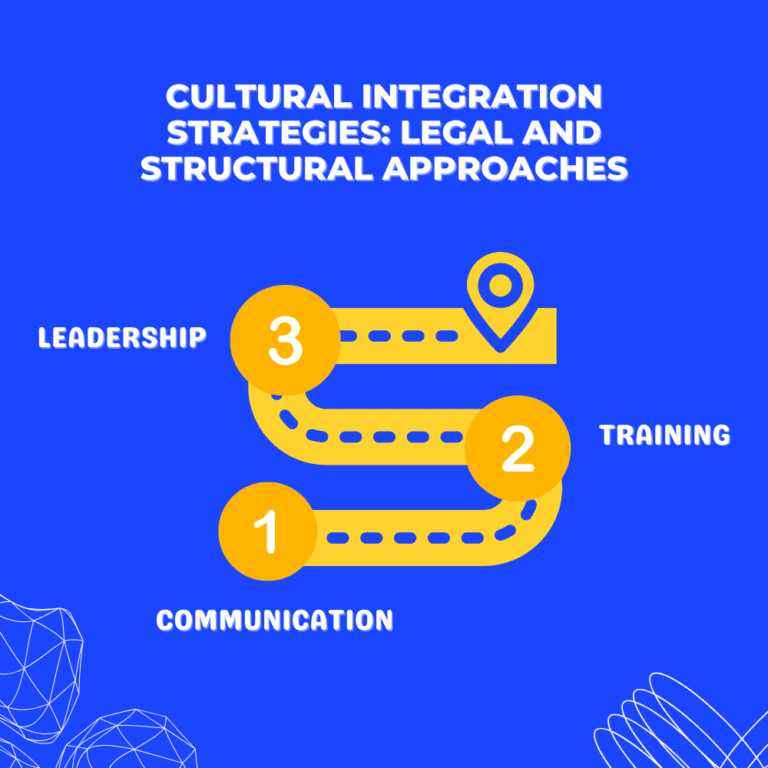
Cultural Integration Strategies: Legal and Structural Approaches

Communication: The Backbone of Transparency

Transparent communication is vital to bridging cultural gaps. Legal tools such as formal communication plans, confidentiality agreements, and employment contracts help ensure that messaging is consistent and legally protected.

Training: Building Unified Teams

Post-merger training programs can foster cultural cohesion while ensuring compliance with labor laws. Gate One Consulting, for example, emphasizes the importance of structured training to align employees with the new vision. These programs should be tailored to address both cultural and regulatory differences.

Leadership Alignment

Strong, aligned leadership is crucial for cultural integration. Legal teams should formalize leadership roles through:

  • Executive employment agreements.
  • Equity incentive plans to motivate shared success.
  • Decision-making protocols to minimize conflicts.

Ready to create a strong post-merger leadership structure?

Visit Linden Law Partners for professional legal advice.

3. Challenges and Legal Solutions in Post-Merger Cultural Integration

Resistance to Change

Resistance to new processes or policies is a common cultural barrier. Deloitte’s report suggests using formal change management agreements to ease transitions. These agreements can clarify expectations and mitigate litigation risks arising from employee dissatisfaction.

Loss of Key Employees

Cultural misalignment is one of the top reasons employees leave after an M&A transaction. Retention strategies such as bonuses, restrictive covenants, and transitional agreements can mitigate this risk.

Governance and Compliance

Aligning governance structures across merged entities is essential. Legal teams should:

  • Integrate compliance policies to create a unified framework.
  • Use joint operating agreements to establish clear governance.

4. The Role of Legal Advisors in Cultural Integration

Legal advisors are instrumental in fostering cultural harmony. Their responsibilities include:

  • Drafting Agreements: Tailoring employment contracts, governance frameworks, and operating agreements to address cultural nuances.
  • Resolving Conflicts: Establishing dispute resolution mechanisms to handle cultural disagreements efficiently.
  • Monitoring Integration: Providing ongoing counsel to ensure cultural initiatives comply with regulatory standards and remain aligned with organizational goals.

Partner with specialists who understand the nuances of cultural integration.

Call Linden Law Partners today at 303-731-0007.

5. Case Studies: Cultural Integration Done Right

Case Study 1:

A merger in the manufacturing industry highlights the importance of proactive cultural alignment. The acquiring company implemented cultural audits, structured retention bonuses, and leadership workshops as part of the integration plan. These legal and HR-driven strategies minimized turnover and improved operational efficiency. This example underscores how collaboration between legal and HR teams can address cultural integration challenges effectively.

Case Study 2:
A technology company merging with a smaller firm faced challenges with differing workplace flexibility policies. Legal advisors structured agreements that standardized work-from-home policies, ensuring fairness across the merged entity. Retention bonuses were also implemented for key employees, leading to a seamless cultural transition.

6. Actionable Steps for Selling and Buying Entities

For Sellers:
  • Prepare for cultural evaluations during due diligence.
  • Disclose potential cultural challenges and legal risks.
For Buyers:
  • Include relevant representations and warranties in the Purchase and Sale and Purchase Agreement (SPA).
  • Leverage legal tools like retention contracts and governance protocols to mitigate integration risks.

Conclusion

Cultural integration is not merely a “soft” aspect of M&A—it’s a cornerstone of post-closing success. Legal teams play a pivotal role in addressing cultural issues, from drafting agreements to managing compliance risks. By combining legal expertise with proactive cultural strategies, businesses can maximize the value of their M&A transactions.

Contact us today to learn how our legal expertise can help you navigate the complexities of cultural integration in M&A.

Call us at 303-731-0007 or email [email protected] to schedule a consultation.

The Importance of the Due Diligence Process for Selling Business Owners

Introduction

Selling a business is both a culmination of your hard work and a critical financial decision. For business owners, particularly those targeting private equity or institutional buyers, the due diligence process is not just a formality—it’s a pivotal stage that can influence deal success, speed, and valuation. Proactively preparing for due diligence helps you demonstrate credibility, resolve potential concerns, and negotiate with confidence.

If you’re preparing to sell your business, Linden Law Partners can guide you through the complexities of due diligence to help ensure an efficient and successful transaction.

1. Reverse Due Diligence: Setting the Stage for Success

What Is Reverse Due Diligence?

Reverse due diligence is the proactive process of examining your business as if you were the buyer. It involves a comprehensive review of operations, financials, legal agreements, and organizational structures to identify weaknesses and resolve them before buyers scrutinize your company.

Reverse due diligence
Reverse due diligence process

Why It Matters

  • Builds Buyer Trust: Transparency fosters confidence in the transaction.
  • Minimizes Surprises: Identifying and addressing red flags in advance reduces disruptions during negotiations.
  • Streamlines the Sale: A prepared business accelerates the due diligence timeline, enhancing the buyer experience.

For instance, cleaning up financial inconsistencies or resolving outdated contracts can drastically improve buyer perceptions and negotiation outcomes.

2. Key Areas of Acquirer Due Diligence

Buyers typically focus on several critical aspects when evaluating a business. Here’s a closer look at what they’ll analyze:

  • Systems & Operations: Can the business operate efficiently without the seller? Well-documented workflows and processes signal continuity and scalability.
  • Market Position & Growth Potential: How strong is your competitive positioning? Buyers assess market share, customer retention, and opportunities for growth.
  • Financial & Tax Compliance: Transparent and accurate financial records are dealmakers. Expect buyers to scrutinize cash flow and financial statements (at a “Quality of Earnings” level, tax filings, historical earnings, and remodeled financials showing growth potential.
  • Talent & Team Dynamics: A well-aligned team with clear roles and a retention plan is critical for seamless transitions.
  • Legal and Organizational Structure: Clean and transferable legal agreements and intellectual property protections prevent post-sale complications.

3. Preparing for Due Diligence by Category

A. Systems & Operations

Start by mapping workflows and creating detailed documentation for business systems. This ensures buyers can clearly see how operations will continue post-acquisition.

B. Market Analysis

Analyze your market position, customer base, and supplier relationships. Highlight strong retention metrics, diverse suppliers, and contracts that secure stability.

C. Financial and Tax Readiness

Upgrade your financial systems to withstand private equity scrutiny. Adjustments to EBITDA and detailed quality of earnings (Q of E) reports are essential for aligning with buyer expectations.

D. Legal and Compliance

Review and formalize governance structures, ensuring agreements are transferable and compliance is up-to-date. Addressing these factors early avoids transaction delays.

4. Building the Right Team for Due Diligence

Navigating due diligence requires an experienced team that can handle the nuances of M&A deals. Consider the following key roles:

  • Legal Advisors: Ensure compliance, resolve legal ambiguities, and handle contractual transitions.
  • Financial Experts: Provide accurate valuations, manage tax strategies, and prepare Q of E reports.
  • Operational Consultants: Tackle scalability concerns and improve systems efficiency.

Advisors with “scar tissue”—experience from tough deals—can anticipate challenges and develop strategies to overcome them.

5. Common Red Flags That Derail Deals

Common Red Flags That Derail Business Deals

Unaddressed issues can erode buyer confidence and jeopardize deals. cinclude:

  • Financial Inconsistencies: Inaccurate financial records or unexplained variances.
  • Non-Transferable Agreements: Vendor or customer contracts that don’t transfer automatically.
  • Hidden Liabilities: Environmental, tax, or legal obligations lurking beneath the surface.
  • Customer Retention Metrics: Overstated or misleading data regarding customer loyalty.

Proactively resolving these issues ensures smoother negotiations and avoids last-minute price reductions.

6. Enhancing Market Appeal

Buyers are drawn to businesses that offer stability and growth potential. Strengthen your appeal by:
  • Formalizing governance and decision-making structures.
  • Reviewing and optimizing key contracts for transferability.
  • Securing intellectual property and industry-specific permits to safeguard compliance.

7. Practical Steps for Due Diligence Readiness

A. Documentation

Organize legal, financial, and operational records into a centralized and easily accessible format.

B. Management Retention

Secure commitments from key leaders to reassure buyers of operational stability post-sale.

C. Tax and Compliance

Ensure all tax filings are accurate, up-to-date, and aligned with buyer expectations.

D. Employee Agreements

Clarify roles and enforceability of employee contracts to minimize disruptions.

8. Benefits of Being Due Diligence Ready

Preparing for due diligence yields significant advantages:
  • Faster Timelines: A prepared seller accelerates the deal process.
  • Higher Valuations: Mitigating risks upfront leads to better offers.
  • Reduced Price Adjustments: Comprehensive preparation minimizes buyer concerns.
  • Negotiating Leverage: A well-organized business puts sellers in a stronger bargaining position.

9. Why Selling to Private Equity or Institutional Buyers Requires Extra Preparation

Private equity and institutional buyers bring higher expectations, emphasizing scalability, data transparency, and compliance. Sellers must present polished financials, growth-ready operations, and transfer-ready contracts to meet these rigorous demands.

Conclusion

The due diligence process is your opportunity to present your business as a credible, stable, and attractive investment. By proactively preparing and addressing potential pitfalls, you position yourself for a smooth and successful transaction.

Need guidance for your business sale?
Contact Linden Law Partners to navigate the due diligence process with speciality precision and confidence.

Negotiation Strategies for Selling Founders in Mergers & Acquisitions: An Ultimate Guide

Navigating the sale of your business can be a transformative, often complex journey. As a founder, understanding the strategies behind effective M&A negotiation can be the difference between a successful exit and leaving value on the table. This guide is tailored to selling founders in Colorado and beyond who want to maximize their outcomes while ensuring a smooth and strategic transaction process.

Key Takeaways

  • Know Your Leverage: Understanding your position in the market, the unique aspects of your business, and your prospective buyers’ motivations is essential to building leverage.
  • Focus on Deal Structure: The deal terms are often just as important as the price. A skilled negotiator prioritizes structure to minimize risk and optimize the final outcome.
  • Preparation is Everything: Entering negotiations with well-organized financials, clear objectives, and a highly skilled team who has seen it all in mergers and acquisitions and who is experienced with advising founders on their exits can greatly strengthen your position and streamline the process.

Why Negotiation Matters for Founders Selling Their Businesses

For selling founders in Denver, Colorado, and across the United States, the negotiation phase is where value is captured. It’s not only about securing the best price but also about structuring a deal that aligns with your long-term goals, protects your interests, and sets the stage for a smooth post-sale transition. Negotiation gives you the opportunity to not only influence your company’s valuation but also shape terms around earn-outs, escrow provisions, promissory notes, rollover equity, representations and warranties, indemnification,, and post-closing employment agreements—all of which are frequently interdependent.

Why Negotiation Matters for Founders Selling Their Businesses

In M&A, negotiation is where valuation meets strategic decision-making. Leveraging data, competitor analysis, and your goals, founders can influence key terms like purchase price and post-closing adjustments. When thoughtfully structured, these elements create a transaction that maximizes value and minimizes post-sale risks.

By working with local M&A advisors like Linden Law Partners who are familiar with the business landscape of Colorado, Denver founders can leverage competitor analysis and strategic insights to maximize deal outcomes while minimizing risks.

1. Building Your M&A Team

A strong regionally aware team of M&A advisors is essential for successful negotiation. Your advisors aren’t merely supporting players—they’re the backbone of your negotiation strategy. Consider building a team that includes:

  • M&A Attorneys in Colorado: Your attorney will draft and negotiate terms that protect your interests, from the purchase agreement, earnouts, rollover equity agreements, post-closing employment agreements, representations and warranties, indemnification provisions, non-compete agreements, and more. They ensure the contracts match the financial elements, manage legal compliance around the dal, address tax concerns, and help you guard against liabilities that could otherwise arise post-sale.
  • Investment Bankers or Brokers: These professionals help drive competitive bidding, develop “books” or “confidential information memorandums,” articulate the unique value of your business, and manage the flow of financial information. Investment bankers and brokers can identify high-fit buyers who may pay a premium based on your company’s unique strengths.
  • Accountants and Tax Advisors: Financial experts bring transparency, validate valuations, and manage tax impacts. Strong financial records build buyer trust and underscore valuation, while tax advisors help structure the deal for efficiency.
  • Industry Specialists with regional insight: Industry experts who know Denver market landscape (or other applicable localized markets) and trends can help identify and highlight what makes your company valuable within a competitive field.

By assembling a well-rounded advisory team of Denver, Colorado based M&A professionals, you’ll be equipped to anticipate challenges and optimize every phase of negotiation.

2. Establishing Clear Goals and Priorities

Before entering negotiations, it’s essential for business owners in Denver, Colorado (and beyond) to clarify their objectives, as they will directly shape how you negotiate and which terms you prioritize. Key questions to consider include:

  • What’s your target valuation range? Set a baseline figure based on your company’s financial health and projected performance.
  • Are you open to an Earnout or Rollover Equity? If maintaining a stake in the business post-sale is an option, define the conditions under which this makes sense. Earnouts and rollover equity are frequently used to align seller incentives with the business’s future success.
  • How much risk are you comfortable with? Indemnification, representations and warranties, and earn-outs directly affect post-sale liability.
  • What role do you want post-sale? Define expectations for any ongoing involvement, as this impacts post-closing employment agreements and potentially aligns with rollover equity.

Establishing clear goals keeps you aligned with your advisory team and ensures each negotiation aspect is tailored to what matters most.

Establishing Clear Goals and Priorities

3. Preparing for Buyer Due Diligence and Becoming Quality of Earnings (QoE) Ready

Presenting well-structured financials is vital for smoother M&A transactions. A Quality of Earnings (QoE) report provides a detailed, accurate view of your company’s earnings, allowing potential buyers to assess profitability and potential risks. Being QoE-ready not only strengthens your negotiating position but also smooths the due diligence process. Here’s how to prepare:

  • Organize Financials and Key Metrics: QoE reports require a comprehensive look at your financials. Prepare balance sheets, historical and current income statements, and cash flow projections.
  • Clean Up One-Time Expenses: Removing non-recurring or non-operational expenses from your financials helps provide a clearer picture of normalized earnings, which buyers will assess closely.
  • Address Potential Adjustments: If your business has any discretionary expenses or personal expenses reflected in financial statements, adjust them to show a more accurate earnings baseline.

Preparing a QoE report reduces buyer concerns and minimizes the risk of valuation adjustments, helping you maintain leverage in negotiations. Engage an accounting specialist who is familiar with the QoE process on behalf of selling founders.

4. Creating Competitive Tension

One of the most effective ways to enhance bargaining power is by creating a competitive bidding environment. Engaging multiple prospective buyers can improve both the final offer and negotiation terms.

  • Run a Structured Sales Process: Engage multiple prospective buyers in a staged approach managed by your investment banker or broker.
  • Include Diverse Buyer Types: Strategic buyers may value synergies, while financial buyers (think private equity) focus on returns. Each type brings distinct priorities, adding options and leverage.
  • Control Information Disclosure: Gradually release information to keep potential buyers engaged and maximize leverage.

Creating a competitive tension within Denver, Colorado’s M&A landscape encourages stronger offers and more favorable deal terms, as buyers often strive to outbid each other.

5. Understanding and Leveraging Deal Structure in M&A Transactions

The structure of an M&A deal can significantly impact the transaction’s success and your financial outcome. Sellers should focus on deal structure components, including rollover equity, payment terms, deferred payment terms (such as earnouts or promissory notes), working capital adjustments, indemnification, and representations and warranties.

  • Rollover Equity: Rollover equity allows you to retain partial ownership and aligns incentives with the new ownership team. Clearly define the terms around rights, influence, and financial expectations.
  • Payment Terms: Cash upfront offers security, but earn-outs or deferred payments may yield a higher final price. Match terms to your risk tolerance and timeline.
  • Earnouts: Earn-outs link a portion of the sale price to the business’s future performance, often used to bridge valuation gaps and create shared success incentives. Carefully structured earn-outs are critical to protect your interests and reduce the risk of dispute.
  • Promissory Notes: Promissory notes are used defer part of the sale price by issuing a note to the seller, often prioritized below senior debt in repayment order (known as ‘subordinated promissory notes’). These notes offer benefits but also carry significant risks if not structured carefully
  • Working Capital Adjustments: Adjustments to working capital ensure the company operates smoothly by confirming it has sufficient capital to meet ongoing obligations. Buyers and sellers should negotiate the target working capital amount based on a defined metric (such as average working capital over 12 months) to prevent last-minute valuation changes.
  • Representations and Warranties; Indemnification: Representations and warranties are assurances about various aspects of your company that buyers rely on to confirm the business is as presented. These statements cover key areas, such as financial condition, legal compliance, and operational health. If any representation or warranty proves inaccurate, you, as the seller, may be obligated to “indemnify” the buyer, covering associated losses or damages. Understanding market standards and carefully structuring representations and warranties can significantly limit your liability and mitigate future risks.

Deal structure impacts your exposure to future claims and overall exit value. For instance, favorable rollover equity terms can be impacted by the termination of post-closing employment agreements, and accurate representations and warranties can limit your risk of indemnification claims—which impacts the net proceeds founders ultimately retain.

6. Negotiating Valuation in M&A deals

Negotiating Valuation in Denver M&A deals
Valuation is a focal point in M&A negotiations, but it goes beyond a single price figure. Selling founders should identify and focus on the specific valuation driver for their industry—whether it’s Annual Recurring Revenue (ARR) in tech or EBITDA in manufacturing. Knowing the primary valuation metric helps strengthen your position and aligns your pitch with buyer expectations. Approach valuation strategically by:
  • Using Multiple Valuation Methods: Different methods, like comparable transactions, ARR, or EBITDA multiples, provide unique insights depending on the industry. Presenting a mix of methods helps validate your valuation range and prepares you for price discussions.
  • Emphasizing Unique Value Drivers: Highlight value-adding factors beyond financials, such as intellectual property, brand equity, or competitive positioning. Demonstrating these factors can justify a premium, especially in markets where these intangibles weigh heavily in buyer evaluations.
  • Defending Key Assumptions: Be prepared to substantiate your valuation with robust data, assumptions, and projections, showing buyers it’s both realistic and achievable.

A well-supported valuation narrative not only aligns with industry standards, but also strengthens your negotiating position by illustrating the comprehensive worth of your business.

7. Establishing Proper Working Capital Adjustments to Protect Value

Working capital adjustments ensure that the company’s current assets (excluding cash) and current liabilities are at an agreed-upon level when the sale closes. These adjustments are critical for businesses in the Denver area to prevent fluctuations in working capital from impacting the transaction value, and to protect both parties’ interests.

  • Setting a Target Amount: Define a target working capital level based on historical data, such as the company’s average working capital over the past 12 months. This approach helps establish a fair baseline and minimizes last-minute disputes.
  • Adjustments at Closing: Following closing, compare the actual working capital with the target as of the closing. If working capital falls below this level, the purchase price may be reduced to account for the shortfall. Conversely, if it exceeds the target, sellers may receive an additional payment.
  • Avoiding Manipulation: To ensure accurate adjustments, restrict changes to financial operations leading up to the sale. Buyers and sellers should agree on maintaining standard operating expenses and avoid adjustments that artificially inflate or reduce working capital.
  • Mitigating Risk: Clearly outline the scope of adjustments, which specific items are included in working capital, and any exclusions. A transparent working capital mechanism reduces ambiguity and risk for both parties.

By structuring working capital adjustments thoughtfully, you can protect the transaction value and facilitate a smoother closing process, minimizing potential surprises.

Want to ensure your working capital adjustments are structured correctly?
Reach out to our M&A experts to discuss how we can protect your transaction value.

8. Structuring Earnouts to Protect Your Interests

Businessman sitting on stack of gold coins and man with cash

Earnouts tie a portion of the sale price to the company’s post-sale performance, offering a way to bridge differences in valuation. However, earnouts can be complex and carry risks if not carefully structured. Here’s how to use them effectively in Denver’s competitive M&A market and elsewhere:

  • Define Clear, Measurable Metrics: Revenue, EBITDA, or gross profit are common benchmarks. Clear metrics reduce ambiguity and make it easier to track performance.
  • Set a Reasonable Earn-Out Period: Most earn-outs range from 1-3 years, depending on the industry and business model. Shorter periods limit prolonged risk, especially if you’re no longer involved in the acquired business post-sale.
  • Limit Buyer Control Over Earn-Out-Related Decisions: Negotiate to retain influence over critical decisions impacting earn-out performance, such as budgets, hiring, operational changes, or other “major decisions” involving the acquired business. Otherwise, the buyer could make decisions that inadvertently affect performance and limit your ability to achieve some or all of the earnout.
  • Protect Against Manipulation: Include clauses that prevent buyers from engaging in behaviors that might artificially reduce the earn-out, like increasing expenses or undercutting revenues.

While earnouts can maximize valuation, structuring them carefully minimizes the potential for disputes and helps ensure you are compensated fairly for the company’s future performance.

Ready to structure your earnout for optimal value?
Contact us today to learn how to align your post-sale performance with your financial goals.

9. Understanding Subordinated Promissory Notes and Their Risks in M&A Deals

Subordinated promissory notes are often used in M&A Transactions to bridge financing gaps by allowing the buyer to issue a note to the seller instead of paying a portion of the price upfront. These notes are subordinated to senior debt, meaning they’re paid only after senior creditors are satisfied.

  • Pros and Cons: Subordinated promissory notes can enable the deal to close without additional upfront cash but place sellers at a financial disadvantage. Sellers should weigh the benefit of securing a note against the risk of delayed payment or default.
  • Risk of Subordination: Because subordinated notes are lower in priority, they carry a higher risk of non-payment if the company faces financial difficulties post-sale. Understanding the buyer’s capital structure is crucial.
  • Mitigating Risk: If accepting a subordinated note, negotiate specific terms, such as higher interest rates, protective covenants, and provisions for accelerating payment if certain conditions arise.

Subordinated promissory notes may bridge funding gaps but require careful structuring to mitigate the inherent risks of being junior in priority to senior lenders.

Concerned about subordinated promissory notes and their risks?
Get in touch with our advisors to navigate these complexities and secure your financial interests.

10. Planning for Post-Sale Transition

A well-planned transition ensures continuity and preserves business integrity of your company after the sale in Colorado’s competitive market.

  • Define Your Transition Role: Clearly outline your role—whether advisory or operational—during the transition.
  • Negotiate Employment Agreements: If staying on, ensure employment terms reflect your compensation, authority, and responsibilities.
  • Address Cultural Integration: If there are cultural differences, discuss alignment strategies to ensure a smooth employee and customer transition.

An employment agreement that aligns with your objectives is essential, particularly if rollover equity or deferred payments are involved.

Need help planning your post-sale transition for long-term success?
Let’s discuss how you can ensure a smooth and strategic exit.

11. Addressing Tax Implications in M&A Transactions

Tax planning is essential to maximize the after-tax value of your sale proceeds. Collaborate with tax advisors and your M&A attorney to consider tax ramifications carefully.

  • Structure for Capital Gains: Structure the deal for maximum capital gains treatment, which may lower your tax burden.
  • Plan for Deferred Payments: Consider the tax treatment of earnouts, deferred payments, or rollover equity, especially for potential tax events.
  • Stock vs. Asset Sale: Each type of sale has different tax implications; structure it based on your entity type and goals.

Tax-efficient planning can significantly impact net proceeds, preserving more of the sale value.

Maximize your after-tax proceeds with strategic tax planning.
Contact our team to get expert guidance on structuring your deal.

12. Navigating Non-Compete and Non-Solicit Agreements in M&A Deals

Non-compete and non-solicit agreements often accompany M&A deals to protect the buyer’s investment. However, overly restrictive terms may hinder your future prospects.

  • Negotiate Duration and Scope: Non-competes should be reasonable in scope and time to avoid unnecessary restrictions.
  • Focus on Non-Solicit Clauses: Non-solicits may protect the buyer while allowing more career freedom.
  • Clarify Permissible Activities: Define permissible roles or business ventures to align interests.

Balanced restrictive covenants protect both parties while giving you flexibility for future opportunities.

Worried about restrictive non-compete or non-solicit clauses?
Let’s talk about how to negotiate terms that protect your future opportunities.

13. Preparing for Closing and Beyond in M&A Deals

Preparing for Closing and Beyond in Denver M&A Deals

The final phase focuses on ensuring all agreed terms translate into a closed deal. Prioritize these final steps:

  • Final Document Review: Ensure all terms match negotiations to avoid ambiguities.
  • Plan Regulatory Compliance: Complete any required filings or obtain approvals.
  • Communication with Stakeholders: Inform employees and customers as needed to minimize uncertainty.

Closing preparation helps ensure an efficient exit, securing your desired outcome.

Ready to close the deal?
Ensure a smooth transition with our final preparations checklist. Connect with us for expert assistance every step of the way.

Final Remarks on M&A Negotiations from Denver, Colorado

The M&A negotiation process is both an art and a science, requiring financial insight, strategic planning, and key legal protections. For selling founders, properly addressing key elements— like earnouts, working capital adjustments, escrows, subordinated promissory notes, rollover equity, indemnification, representations and warranties, and post-closing employment agreements—can maximize value and protect your interests. With a strong M&A advisory team and well-defined goals, you’re positioned for a successful exit and legacy.

Position your company for a successful exit today!
Contact our M&A advisory team to start crafting a strategy that maximizes value and safeguards your legacy.

Frequently Asked Questions

What key advisors should be part of my M&A team?

A strong M&A advisory team should include an M&A attorney, investment banker or broker, accountant, tax advisor, and industry expert. These advisors help manage negotiation terms, ensure financial transparency, and structure the transaction to protect your interests.

How can I best prepare for buyer due diligence?
Organize comprehensive financials, address any outstanding legal or compliance issues, and consider obtaining a Quality of Earnings (QoE) report. A QoE report offers a detailed view of earnings and can improve buyer confidence in the transaction.
What is the purpose of an earnout in M&A, and how can it be structured effectively?

An earnout ties part of the sale price to the business’s post-sale performance, helping bridge valuation gaps. To structure it effectively, set clear performance metrics, include provisions for control over key decisions, and add clauses to protect against actions that could manipulate performance outcomes.

Why are working capital adjustments important in an M&A transaction?

Working capital adjustments ensure the business maintains an agreed level of current assets and liabilities at closing, which helps stabilize cash flow expectations. These adjustments prevent valuation fluctuations due to changes in working capital and protect both parties by ensuring the business operates efficiently post-sale consistent with the past practices of the target company.

What role does rollover equity play in an M&A deal?
Rollover equity allows the seller to retain a partial ownership stake, aligning interests with the new ownership team and potentially participating in future growth. Clear terms around rights, influence, and financial expectations are essential to protect the seller’s interests.

Vertical Mergers: Understanding, Benefits, Challenges, and Real-World Examples

Vertical mergers have become a hot topic in today’s business landscape. They involve companies at different stages of the supply chain joining forces in vertical integration efforts. This practice isn’t new; it dates back to the early 20th century when businesses sought efficiency and control over their operations.

Understanding vertical mergers is crucial for grasping market dynamics. They can streamline production, reduce costs, and enhance competitive advantages. However, they also raise concerns about monopolistic practices and market fairness. This ultimate guide dives into vertical mergers, providing real-world examples and insights into their implications. Whether you’re a student, professional, or just curious, this guide will equip you with essential knowledge on vertical mergers.

Key Takeaways

  • Vertical mergers can streamline operations and reduce costs by integrating supply chains, making them beneficial for companies looking to enhance efficiency.
  • Companies should assess potential synergies, such as improved product quality and better customer service, to maximize the advantages of a vertical merger.
  • Be aware of challenges like cultural differences and integration issues that can arise during a vertical merger, and plan accordingly to address these hurdles.
  • Understand the legal implications of vertical mergers, including antitrust laws, to ensure compliance and avoid potential litigation.
  • Analyze real-world examples of successful vertical mergers to gain insights into best practices and strategies that can be applied to your business.
  • Consider how a vertical merger aligns with your long-term business goals and whether it can provide a competitive edge in your industry.

Understanding Vertical Mergers

Understanding Vertical Mergers​

Definition and Purpose

Vertical mergers are collaborations between companies at different stages of the supply chain. They involve firms that operate in a sequential manner, such as a manufacturer merging with a supplier. The primary purpose of vertical mergers is to enhance efficiency and control over production processes. By consolidating operations, companies can reduce costs and streamline their supply chains.

These mergers play a significant role in achieving competitive advantages. Companies can better manage resources and minimize disruptions. Enhanced coordination between different stages of production leads to improved product quality and faster delivery times.

How They Work

The mechanics of vertical mergers focus on the integration of operations across the supply chain. After a merger, companies align their processes to create a seamless flow of goods and services. This integration allows for better inventory management and reduces delays.

For example, a food processing company may merge with a farming operation. This merger ensures that the processor has direct access to raw materials. It creates a more efficient system where suppliers have better visibility into demand from manufacturers. Aligning business strategies is crucial for successful integration. Companies must share goals and objectives for the merger to succeed

Vertical vs Horizontal

Vertical mergers differ from horizontal mergers in key ways. Vertical mergers involve companies at different supply chain levels, while horizontal mergers occur between direct competitors in the same market. For instance, if two car manufacturers merge, it represents a horizontal merger. Conversely, if a car manufacturer merges with a parts supplier, it is a vertical merger.

Each type of merger impacts market structure and competition differently. Vertical mergers can lead to increased control over supply chains but may raise concerns about monopolistic practices. Horizontal mergers often reduce competition by consolidating market power among fewer players.

Which Type of Merger Is Right for You?

When deciding between a vertical merger or a horizontal merger, it is essential to consider the strategic goals of your organization. A vertical merger involves merging with a company in the same industry but at a different stage of the production process, such as a supplier or distributor. This type of merger can help streamline operations, reduce costs, and improve efficiency. On the other hand, a horizontal merger involves merging with a direct competitor, which can help increase market share, expand product offerings, and gain a competitive edge.

If your goal is to improve operational efficiency and control more aspects of the supply chain, a vertical merger may be the right choice for you. However, if you are looking to grow your market presence, diversify your product portfolio, or eliminate competition, a horizontal merger may be more suitable. Ultimately, the type of merger that is right for you will depend on your specific business objectives and industry dynamics. It is important to carefully evaluate the potential benefits and risks of each type of merger before making a decision.

Benefits of Vertical Mergers

Operational Advantages

Vertical mergers create operational efficiencies by streamlining supply chains. Companies can control more stages of production. This control allows for better management of resources and timing. Improved coordination occurs between suppliers and manufacturers.

Fewer delays occur when companies own multiple stages of production. They can respond more quickly to market demands. Reducing operational redundancies is another key advantage. Companies eliminate duplicated efforts across different departments. This leads to cost savings and improved productivity.

Financial Gains

Cost savings are significant in vertical mergers. Reduced supply chain expenses reduce overall operating costs. Companies can negotiate better prices with suppliers when they have more control over the supply chain.

Increased revenue often results from enhanced product offerings. A company can provide a wider range of products or services after a merger. This diversification attracts new customers and retains existing ones.

Economies of scale also play a crucial role in financial performance. Larger companies can spread fixed costs over more units, reducing per-unit costs. This advantage leads to improved profitability.

Managerial Improvements

Decision-making processes improve within vertically merged companies. Management teams gain access to more data across the supply chain. This information leads to informed choices that benefit the entire organization.

Consolidation of management teams enhances efficiency. Leaders from different sectors share insights and strategies. This collaboration fosters innovation and quick problem-solving.

Shared best practices emerge as another benefit of vertical mergers. Companies learn from each other’s successes and failures. This knowledge transfer strengthens overall operations.

Denver Businesses, Let’s Build Your Merger Strategy! 

Reach us at [email protected] or call (303) 731-0007 today to discover whether a vertical or horizontal merger is the best fit for your goals. Schedule a consultation with our Denver-based team now!

Synergies in Vertical Mergers

Enhanced Efficiency

Vertical mergers can significantly streamline production timelines. By integrating operations, companies reduce the time from production to market. This efficiency comes from closer collaboration between suppliers and manufacturers. Delays in the supply chain often decrease as merged companies work together more closely.

Increased productivity follows as a natural result of these integrated operations. When firms combine their resources, they can respond faster to market demands. For example, a manufacturer that merges with its supplier can quickly adjust production schedules based on real-time data. This leads to a more agile business capable of meeting customer needs promptly.

Streamlined Processes

Vertical mergers simplify procurement and distribution processes. With fewer steps involved, companies can operate more smoothly. Eliminating intermediaries is one major benefit of these mergers. By removing middlemen, businesses save costs and enhance communication.

Technology integration plays a crucial role in improving process efficiency. Merged companies often adopt advanced systems that facilitate better inventory management and logistics. For instance, a company that integrates its supply chain technology can track products seamlessly from production to delivery. This integration reduces errors and enhances overall service
quality.

Resource Optimization

Vertical mergers allow for better resource allocation across the newly formed entity. Companies can share facilities, equipment, and personnel, resulting in lower operational costs. Shared resources lead to enhanced productivity and reduced waste.

The potential for innovation also increases through combined research and development efforts. Merging companies bring together diverse expertise and knowledge bases. This collaboration fosters creativity and accelerates the development of new products or services. For example, a tech firm merging with a manufacturing company might create innovative solutions that neither could achieve alone.

Challenges in Vertical Mergers

Challenges in Vertical Mergers​

Additional Costs

Vertical mergers often come with hidden costs. Integration expenses can quickly add up. Companies may need to invest in new systems and processes to combine operations. Restructuring and rebranding efforts also incur significant financial implications. These activities require resources that can strain budgets.

Overestimating synergies poses another risk. Companies might expect greater efficiencies than what is realistic. This miscalculation can negatively affect profitability. Financial projections based on inflated synergies can lead to post-merger disappointment. Thus, careful financial planning is crucial for success.

Cultural Integration

Merging different corporate cultures presents major challenges. Employees from both companies may have distinct values and practices. This difference can create friction during the integration phase. Fostering a unified company culture is essential for long-term success.

Effective communication plays a vital role in this process. Leaders must share a clear vision and goals with all employees. Regular updates help build trust and reduce uncertainty. Training programs can also aid in blending cultures. These initiatives encourage collaboration and understanding among teams.

Legal Considerations

Legal frameworks closely govern vertical mergers. Various regulations exist to ensure fair competition and protect consumers. Companies must conduct thorough due diligence before proceeding with a merger. This assessment helps identify any potential legal risks associated with the deal.

Legal counsel plays an important role during this phase. Experienced M&A lawyers can navigate complex merger agreements effectively. They provide insights into compliance issues and regulatory requirements. Engaging legal experts early in the process minimizes potential pitfalls.

Facing Vertical Merger Challenges? We Can Help! 

Partner with Denver’s trusted M&A advisors to ensure seamless integration and compliance. Let’s discuss your merger needs—reach out at [email protected] or call (303) 731-0007 to get started.

Legal Aspects of Vertical Mergers

Antitrust Laws

Antitrust laws play a crucial role in assessing vertical mergers. These laws aim to prevent anti-competitive behavior that can harm consumers. Regulators analyze how these mergers might reduce competition in the market. They focus on whether the merger creates monopolistic power or reduces consumer choice.

Evaluation criteria include market share and the potential for price increases. If a merger leads to higher prices or reduced innovation, regulators may challenge it. Companies must also consider how their merger affects suppliers and customers. A merger that harms any part of the supply chain could raise red flags.

Compliance is essential for companies pursuing vertical mergers. Non-compliance can lead to legal challenges after the merger is complete. This could result in fines, divestitures, or even the dissolution of the merger. Companies should proactively address these concerns during negotiations.

Regulatory Compliance

Several regulatory bodies oversee vertical mergers. The Federal Trade Commission(FTC) and the Department of Justice (DOJ) are the primary authorities. in the United States They evaluate proposed mergers to ensure they comply with antitrust laws. Other countries have similar agencies, such as the European Commission in Europe.

Companies must follow specific steps to ensure compliance with regulations. First, they should conduct thorough market research. Understanding market dynamics helps identify potential issues early on. Next, they should prepare detailed documentation outlining the merger’s benefits and impacts.

Transparency is vital throughout this process. Companies need to communicate openly with regulators about their intentions. Engaging with stakeholders can also foster trust and mitigate concerns about anti-competitive behavior.

Firms should be ready for scrutiny from regulators at all stages of the merger process. This includes pre-merger notifications and post-merger evaluations. Maintaining clear records and justifications for decisions is essential.

Master Legal Aspects of Vertical Mergers in Denver! From antitrust evaluations to regulatory compliance, we provide tailored support. Let’s secure your merger’s success—reach out at [email protected] or call (303) 731-0007 now.

Real-World Examples

eBay and PayPal

eBay and PayPal​

eBay acquired PayPal in 2002 for $1.5 billion. This acquisition aimed to streamline online transactions on eBay’s platform. By integrating PayPal, eBay enhanced the payment process for its users. The merger made online shopping easier and more secure.

The impact of this merger was significant. Users experienced faster transaction times. They could complete purchases without leaving the eBay site. This efficiency improved customer satisfaction and loyalty.

Long-term benefits emerged for both companies. eBay increased its market share in online auctions. PayPal expanded its customer base, becoming a leading online payment service. The partnership allowed both companies to thrive in the evolving digital landscape.

IKEA Forest Acquisition

IKEA’s acquisition of Romanian and Baltic forests occurred in 2017. The company aimed to secure sustainable raw materials for its products. Owning forests helps IKEA better control its supply chain.

This acquisition supports IKEA’s sustainability goals. It ensures a steady supply of wood while promoting responsible forestry practices. The forests provide renewable resources, reducing environmental impact.

IKEA’s supply chain benefits from this move. The company can maintain product quality with reliable raw material access. This strategy aligns with consumer demand for sustainable products.

Inditex and Indipunt

Inditex acquired Indipunt in 2021 to strengthen its textile sourcing capabilities. This strategic decision focused on sustainable textiles, aligning with global trends. Indipunt specializes in ecofriendly fabric production.

The merger enhances Inditex’s commitment to sustainability. It allows the company to offer more environmentally friendly clothing options. Consumers increasingly prefer brands that prioritize sustainability.

Supply chain efficiency improved as a result of this acquisition. Inditex streamlined its operations by integrating Indipunt’s resources. This led to reduced costs and faster product delivery times.

Summary

Vertical mergers can reshape industries. They offer benefits like cost savings and improved efficiency. However, they also come with challenges, including regulatory scrutiny and integration hurdles. Understanding these dynamics is crucial for navigating the complexities of such mergers.

As you explore vertical mergers, consider how they can enhance your business strategy. Leverage the synergies while being mindful of potential pitfalls. Stay informed about legal aspects to avoid costly mistakes. Dive deeper into real-world examples to inspire your own decisions. Embrace the potential of vertical mergers to drive growth and innovation in your organization. Start evaluating your options today for a competitive edge!

Ready to Drive Growth Through Vertical Mergers?

Unlock the potential of vertical mergers to transform your business. From cost savings to improved efficiency, the opportunities are immense—yet navigating challenges like regulatory compliance is crucial. 

Contact Linden Law Partners for expert guidance tailored to your business needs. Email us at [email protected] or call (303) 731-0007 today!

Let’s strategize together! Contact our Denver-based specialists today to explore tailored solutions for your merger journey.

Frequently Asked Questions

What is a vertical merger?

A vertical merger occurs when two companies in different stages of production combine. This can enhance efficiency and reduce costs by streamlining supply chains.

What are the benefits of vertical mergers?

Vertical mergers can lead to cost savings, improved supply chain management, and increased market control. They often result in enhanced product quality and customer satisfaction.

How do synergies work in vertical mergers?
Synergies in vertical mergers arise from combining resources and capabilities. This can lead to reduced operational costs and improved innovation through shared expertise and technology.
What challenges do companies face with vertical mergers?
Companies may encounter regulatory scrutiny, integration difficulties, and cultural clashes. These challenges can hinder the expected benefits of the merger if not managed properly.
Yes, legal aspects include antitrust laws that prevent monopolistic practices. Companies must ensure their merger complies with regulations to avoid penalties or forced divestitures.
Can you provide an example of a successful vertical merger?

One notable example is Disney’s acquisition of Pixar. This merger allowed Disney to enhance its animation capabilities while benefiting from Pixar’s innovative technology and creative talent.

How can businesses prepare for a vertical merger?

Businesses should conduct thorough due diligence, communicate effectively with stakeholders, and develop a clear integration plan. This preparation helps maximize the merger’s potential benefits.

Rebound of M&A in 2024: Key Drivers & Seller Opportunities

The rebound of mergers and acquisitions (M&A) activity in 2024 is reshaping the business landscape. After a period of stagnation, companies are now actively pursuing strategic partnerships and acquisitions to drive growth and innovation. This resurgence in M&A activity is fueled by a combination of favorable market conditions, increased investor confidence, and a focus on expanding market share. As businesses navigate a rapidly evolving economic environment, M&A deals are emerging as a key strategy to stay competitive and capitalize on new opportunities. Stay tuned as we delve into the latest trends, challenges, and opportunities in the dynamic world of mergers and acquisitions.

Key Takeaways

  • Stay informed about the rebound of mergers and acquisitions (M&A) activity in 2024 to capitalize on potential opportunities.
  • Understand sector-specific M&A trends to tailor your approach and strategies for maximum impact.
  • Acknowledge the challenges in M&A recovery and proactively address them to navigate the process more effectively.
  • Pay attention to signals for future deal-making, such as economic indicators and market dynamics, to make informed decisions.
  • Implement key steps for successful deals, including thorough due diligence, clear communication, and strategic planning.
  • By following these insights, you can position yourself better in the evolving landscape of M&A activities in 2024.

M&A Market Outlook for 2024

Current Market Performance

Recent data reveals a robust rebound in mergers and acquisitions (M&A) activity, signaling a positive trend. Sectors such as technology, healthcare, and renewable energy are experiencing significant growth in M&A deals. Economic factors like stable interest rates and increased investor confidence contribute to the buoyant market performance.

Expected Trends

The resurgence of M&A is expected to span across various industries, driven by strategic consolidations and market expansions. As the market evolves, buyer and seller dynamics are likely to shift, with sellers gaining more leverage. Technological advancements, especially in digitalization and automation, will shape future M&A strategies, emphasizing efficiency and scalability.

Key Drivers

Economic recovery acts as a primary driver fueling M&A activity, providing companies with growth opportunities through strategic acquisitions. Low-interest rates play a crucial role in facilitating mergers by reducing financing costs. Corporate strategies are adapting to embrace acquisitions as a means of achieving competitive advantages and expanding market presence.

Opportunities for Sellers

Sellers in 2024 can capitalize on favorable market conditions characterized by high demand for quality assets. Competitive sectors offer opportunities for premium valuations, attracting sellers looking to maximize returns. Strategic positioning is paramount for sellers to stand out in a crowded market, emphasizing unique value propositions to attract potential buyers.

Ready to explore your next M&A opportunity? Connect with our team for specialized guidance on navigating the Denver, Colorado business market in 2024.

Sector-Specific M&A Trends

Technology Sector

The technology sector is witnessing a surge in tech-related mergers and acquisitions as companies seek to enhance their capabilities. Innovation plays a pivotal role in driving consolidation within the tech industry, with major mergers reshaping the competitive landscape. Companies are strategically acquiring innovative startups to stay ahead of the curve and expand their market presence. The rise of disruptive technologies like artificial intelligence and blockchain is fueling M&A activity in the tech space.

Cybersecurity concerns have become a significant factor influencing tech M&A strategies, with companies prioritizing data protection and privacy measures. As cyber threats continue to evolve, organizations are increasingly looking to strengthen their security infrastructure through strategic acquisitions. The integration of cybersecurity expertise has become a key focus for companies engaging in tech M&A deals to safeguard their digital assets and customer information.

Healthcare Sector

In the healthcare sector, there is a growing trend towards consolidation as companies aim to achieve economies of scale and improve operational efficiency. Regulatory changes, such as healthcare reforms and compliance requirements, are playing a crucial role in shaping healthcare M&A activity. Companies are exploring strategic partnerships and acquisitions to navigate the evolving regulatory landscape and capitalize on new market opportunities.

Telehealth and digital health solutions are driving acquisitions in the healthcare sector, with companies leveraging technology to enhance patient care and streamline healthcare delivery. The increasing adoption of telemedicine services has accelerated digital health M&A transactions, with companies looking to integrate virtual care solutions into their service offerings. The shift towards value-based care models is also influencing M&A decisions in the healthcare industry.

Financial Services

The financial services sector is undergoing transformation due to the disruptive impact of fintech on traditional banking and insurance services. Fintech innovations are reshaping the financial landscape, prompting traditional institutions to explore strategic alliances and acquisitions to stay competitive. Banks are increasingly acquiring tech companies to leverage their digital expertise and enhance customer experiences through innovative solutions.

Regulatory pressures are another key driver shaping mergers in the financial sector, with stringent compliance requirements influencing M&A decisions. Companies are navigating complex regulatory environments by seeking partnerships that offer regulatory expertise and compliance solutions. The convergence of finance and technology is driving collaboration between traditional financial institutions and fintech startups to drive innovation and address evolving customer needs.

Consumer Goods

Changing consumer preferences are impacting M&A activity in the consumer goods sector, with companies focusing on acquiring brands that align with shifting consumer trends. Sustainability has emerged as a key consideration in consumer goods acquisitions, with companies prioritizing environmentally friendly practices and ethical sourcing. Brands that promote sustainability and social responsibility are increasingly attractive targets for acquisition as consumers demand more eco-conscious products.

The rapid growth of e-commerce is also influencing M&A strategies in the consumer goods sector, with companies seeking to expand their online presence and reach a broader customer base. E-commerce platforms are becoming valuable assets for consumer goods companies looking to enhance their digital capabilities and offer seamless shopping experiences. Acquiring e-commerce businesses allows companies to tap into new markets, diversify their product offerings, and strengthen their competitive position in the digital marketplace.

Curious about trends in your sector? Speak with our specialists to understand how these insights can drive your next move.

Challenges in M&A Recovery

Regulatory Hurdles

Companies often face regulatory challenges during M&A transactions, hindering the recovery process. Antitrust laws play a crucial role in determining whether mergers can proceed. International regulations also impact cross-border M&A deals, adding complexity to the transaction process.

  • Companies must navigate through regulatory hurdles to ensure compliance.
  • Antitrust laws aim to prevent monopolies and promote fair competition.
  • International regulations require companies to adhere to diverse legal frameworks.

Economic Uncertainty

The fluctuating economy significantly affects M&A confidence, influencing the pace of recovery. Market volatility directly impacts acquisition activity, leading to hesitancy among companies. To mitigate risks, businesses devise strategies to adapt to economic uncertainties effectively.

  1. Economic fluctuations create challenges for companies engaging in M&A activities.
  2. Market volatility can deter companies from pursuing mergers and acquisitions.
  3. Companies employ various strategies to manage risks associated with economic uncertainty.

Valuation Discrepancies

Valuation gaps between buyers and sellers pose significant challenges during M&A negotiations. Market conditions heavily influence asset valuations, causing discrepancies in perceived values. Differing expectations between parties can complicate negotiations and prolong the deal-making process.

  • Understanding the causes of valuation discrepancies is crucial for successful mergers.
  • Market conditions can lead to varying perceptions of asset values.
  • Negotiating parties must align their expectations to bridge valuation gaps effectively.

Facing regulatory or market challenges? Contact us today to help you overcome obstacles and secure a successful deal.

Signals for Future Deal-Making

Market Indicators

Investors closely monitor corporate dealmaking trends and economic conditions to anticipate future M&A activity. Robust dealmaking often correlates with positive market indicators, such as rising stock prices and increased deal volumes. The frequency of notable deals and megadeals also serves as key signals for the overall health of the M&A landscape.

The performance of the stock market plays a crucial role in shaping deal timing and decision-making processes for corporate dealmakers. A strong market performance typically instills confidence among investors, leading to an uptick in regional deal activity and large deal activity. Conversely, downturns in the market may prompt companies to delay or reassess their M&A plans.

Economic reports provide valuable insights into the financial landscape, influencing corporate prospects for potential mergers and acquisitions. These reports offer a snapshot of market conditions, helping dealmakers gauge the feasibility of pursuing domestic deals, global deals, or megadeal activity. By analyzing economic data, companies can better strategize their approach to dealmaking.

Investor Sentiment

Investor sentiment serves as a barometer for the M&A environment, reflecting dealmakers’ confidence in executing strategic transactions. Positive sentiment can fuel an increase in deal flow, while negative perceptions may lead to a slowdown in activity. Shifts in sentiment often prompt companies to adjust their corporate deals strategies accordingly.

Geopolitical events have a significant impact on investor attitudes towards M&A opportunities. Uncertainty stemming from political developments or global crises can create hesitancy among dealmakers, affecting the pace and scale of many deals. Companies must navigate these challenges by staying attuned to geopolitical shifts and adapting their dealmaking strategies accordingly.

Strategic Considerations

Before embarking on M&A endeavors, companies must carefully evaluate several strategic considerations to ensure successful outcomes. Aligning M&A goals with broader business objectives is paramount to avoid missteps and maximize synergies between entities involved in the transaction. Thorough due diligence and risk assessment are essential components of this alignment process.

Market analysis plays a critical role in identifying lucrative opportunities and potential pitfalls in the M&A landscape. Understanding industry trends, competitive dynamics, and regulatory environments can help companies make informed decisions about pursuing dealmaking activities. By conducting comprehensive market research, organizations can mitigate risks and enhance the likelihood of successful acquisitions.

Key Steps for Successful Deals

Due Diligence

Effective deal preparation involves comprehensive due diligence processes to assess risks and opportunities accurately. Conducting thorough research on financial, legal, and operational aspects is crucial for informed decision-making. Rushed due diligence can lead to overlooking critical issues that may later impact deal success.

Common pitfalls in due diligence include inadequate focus on cultural fit, underestimating regulatory risks, and relying solely on financial metrics. Failure to identify these pitfalls can derail M&A deals, resulting in post-acquisition challenges and financial losses. Mitigating these risks requires a meticulous approach to due diligence.

Best practices for conducting effective due diligence include engaging cross-functional teams, leveraging external advisors for specialized expertise, and maintaining clear communication channels. Collaboration between internal and external stakeholders enhances the depth and accuracy of due diligence findings, enabling effective dealmakers to make well-informed decisions.

Negotiation Tactics

Successful M&A transactions hinge on effective negotiation strategies that prioritize mutual value creation. Flexibility during negotiations allows dealmakers to adapt to changing circumstances and align interests for a mutually beneficial outcome. Rigidity in negotiation tactics can hinder progress and lead to deal stagnation.

Communication plays a pivotal role in negotiations by fostering transparency, building trust, and resolving conflicts amicably. Active listening, clear articulation of expectations, and open dialogue are essential components of successful negotiation processes. Establishing a collaborative atmosphere promotes constructive discussions and paves the way for agreement.

Integration Planning

A well-defined integration strategy post-acquisition is essential for realizing synergies and maximizing deal value. Challenges during the integration process often stem from differences in corporate cultures, operational processes, and technology systems. Overcoming these challenges requires proactive planning and effective change management.

Cultural alignment is paramount in ensuring successful integration by fostering unity, minimizing resistance to change, and promoting collaboration across teams. Aligning values, communication styles, and organizational structures facilitates a smooth transition post-acquisition. Investing in cultural integration initiatives strengthens employee morale and boosts overall performance.

Ensure your M&A success—reach out for personalized support on due diligence, negotiation, and integration planning.

Closing Thoughts

Reflecting on the M&A market outlook for 2024, sector-specific trends, challenges faced in the recovery process, signals for future deal-making, and key steps for successful deals, you now possess a comprehensive understanding of the landscape. As you navigate the dynamic realm of mergers and acquisitions, remember to stay agile, informed, and proactive. Embrace the opportunities presented by the rebound in M&A activity to drive growth, innovation, and strategic expansion for your organization.

Incorporate the insights gained from this exploration into your decision-making processes, fostering resilience and adaptability in the face of challenges. By leveraging these learnings, you can position yourself to capitalize on emerging trends and maximize the potential of your M&A endeavors. Stay tuned to the evolving market dynamics and be ready to seize the moment when opportunity knocks.

Looking to capitalize on the M&A rebound? Get in touch for tailored strategies to optimize your mergers and acquisitions.

Frequently Asked Questions

1. What is the current outlook for M&A activity in 2024?

The M&A market is showing signs of rebounding in 2024, with increased activity expected across various sectors. This uptick indicates growing confidence among businesses to pursue strategic deals and investments.

Different sectors are experiencing unique M&A trends in 2024. For example, technology companies are focusing on digital transformation acquisitions, while healthcare sectors are seeing consolidation for better service delivery and efficiency.

3. What are the main challenges hindering the recovery of M&A activities?

Challenges such as regulatory uncertainties, valuation discrepancies, and integration complexities continue to pose obstacles to the full recovery of M&A activities. Overcoming these hurdles requires careful planning, due diligence, and strategic decision-making.

4. How can businesses identify signals for future deal-making opportunities?

Businesses can monitor market trends, competitor activities, and economic indicators to identify potential deal-making opportunities. Staying informed about industry developments and networking within relevant circles can provide valuable insights into upcoming M&A prospects.

5. What are the key steps that can lead to successful M&A deals in 2024?

Successful M&A deals in 2024 require meticulous planning, thorough due diligence, effective communication between parties, alignment of strategic objectives, and post-merger integration strategies. By following these key steps, businesses can enhance their chances of executing successful transactions.